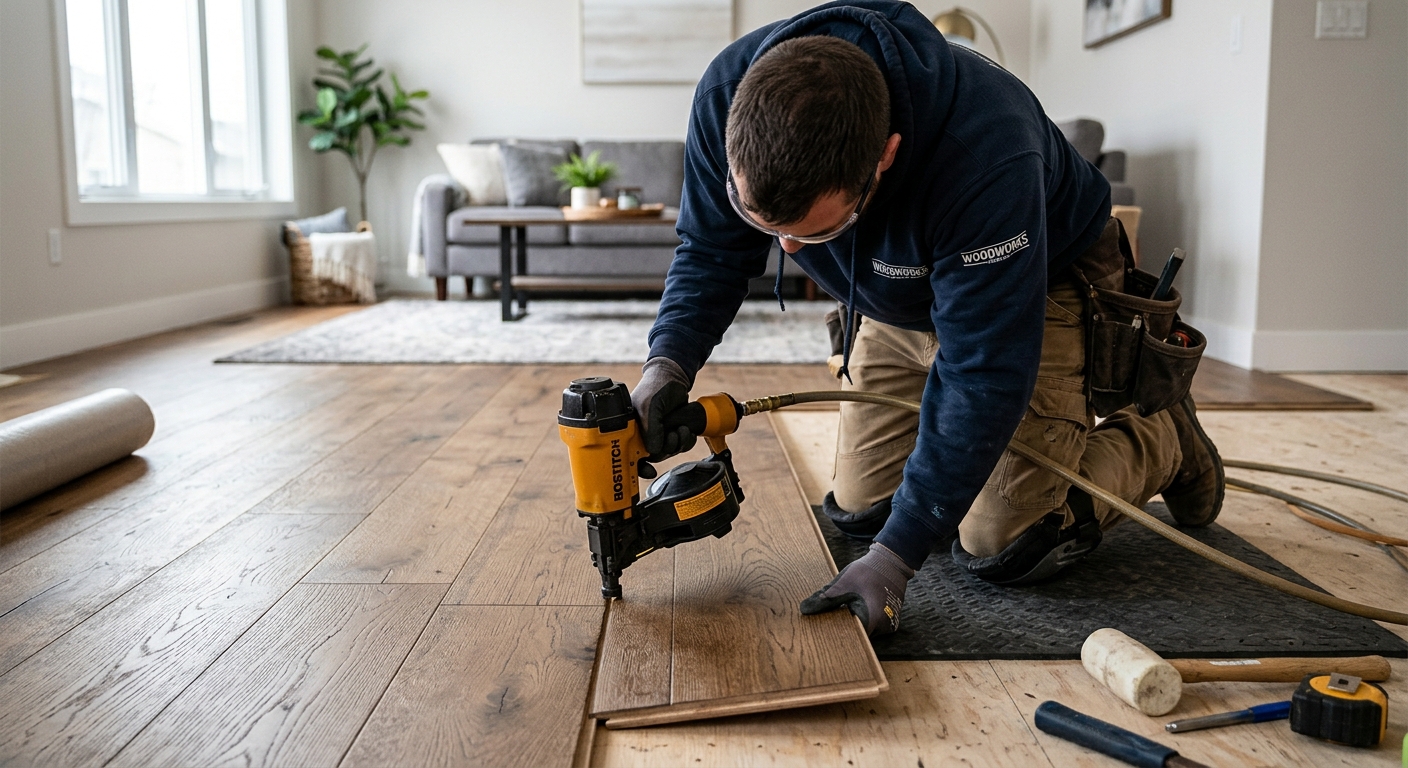
Flooring options and costs in Belleville
Flooring in Belleville is often a balancing act between comfort, budget and moisture control, especially in older homes. With 55,071 residents (Statistics Canada, 2021 Census) and a housing stock where 63.6% of homes were built before 1981, many basements and crawl spaces have a history of humidity swings, prior renovations, and subfloor patching. That matters because an “easy” install rarely stays easy: if the slab or subfloor is uneven, expect levelling, patching or an OSB overlay before the finished surface goes in—often adding measurable labour and materials cost. In the Kingston–Pembroke region, that prep work is a major reason you’ll see the same flooring type quoted at different totals. Basement moisture risk and seasonal indoor humidity changes also influence product choice. In Belleville neighbourhoods such as West Ward (near the downtown core), higher turn-over homes and older foundations commonly push projects toward engineered wood and luxury vinyl plank (LVP) because they better tolerate movement than solid hardwood. Where in-floor heating is present (newer builds and recent renos), radiant-compatible options narrow the field and can add a little planning time for the installer.
For homeowners comparing bids, it helps to look at the installed “band” first, then ask exactly what’s included for prep, moisture mitigation, and transitions. The table below gives typical price ranges for common materials before site-specific upgrades are added.
| Type |
Best Room |
Moisture Resistance |
Lifespan |
Price per sq ft |
| Solid hardwood (nail-down, above grade only) |
Living / dining rooms |
Low (humidity sensitive) |
25–50 years (with refinishing) |
$11,00 – $25,00 |
| Engineered hardwood (float or glue, above + on-grade) |
Bedrooms, main floor |
Medium to high (tolerates movement) |
20–35 years (depending on wear layer) |
$10,50 – $22,00 |
| Laminate (click-lock, above-grade) |
Secondary bedrooms |
Low to medium (water must be addressed fast) |
10–25 years |
$4,50 – $10,00 |
| Luxury vinyl plank / LVP (waterproof, any level) |
Kitchen, basement (finished) |
High (waterproof core) |
15–30 years |
$6,00 – $12,50 |
| Porcelain / ceramic tile |
Bathrooms, entryways |
High (water resistant) |
25–50 years |
$8,50 – $20,00 |
| Carpet (broadloom or modular tile) |
Bedrooms |
Low to medium (needs dry-up after spills) |
7–15 years |
$5,50 – $10,00 |
Prices are estimates only and vary by project scope, site access and material selection.
What affects the price of flooring in Belleville
In Belleville and the wider Kingston–Pembroke region, two similar-looking flooring projects can come in 30–50% apart because quotes are driven less by the finish you pick and more by the hidden prep and moisture realities. Solid hardwood, for example, expands and contracts with indoor humidity—so it can’t be installed over concrete in a way that’s appropriate for basements or high-moisture zones. Engineered hardwood and luxury vinyl plank handle humidity and below-grade conditions far better, which is why they’re common in older homes. Weather and moisture behaviour also affect labour availability and scheduling: when crews are booked around rainy periods (wet basement crawlspaces and longer drying times), prep costs rise.
Older housing stock is a second cost driver. With 63.6% of homes built before 1981 (Statistics Canada, 2021 Census), it’s common to find uneven subfloors, patchy joists, or old flooring that has been glued down multiple times. Levelling or repair often adds roughly $1–$4 per sq ft before the finish even starts. For a real-world example, replacing the same 400 sq ft living area: going from laminate (typically $4–$10/sq ft) to engineered hardwood (often $11–$25/sq ft installed) can raise your material and labour line—yet the jump is usually justified if your subfloor is already flat and you want longer-life refinishing options. Conversely, if the subfloor needs major levelling, paying for premium solid hardwood can backfire because the moisture and floor movement risks may push you toward engineered or LVP instead.
Below-grade installs show the price differences most clearly. In many Belleville basements, solid hardwood is typically ruled out; LVP’s waterproof core can avoid costly moisture remediation steps that would be required to make solid wood viable.
| Price Factor |
Why It Matters |
Cost Impact |
| Room area in sq ft |
More square footage means higher material use and longer labour hours. |
Direct: scales both material and installation labour. |
| Subfloor condition |
Levelling, patching, squeaks or repairs must be handled before the finish goes down. |
Commonly adds about $1–$4 per sq ft for repair/levelling. |
| Moisture / below-grade install |
Humidity swings and basement moisture risk change product suitability. |
Solid hardwood often becomes unsuitable; remediation can add budget. |
| Material choice |
Solid hardwood, engineered, LVP, laminate and tile have different assembly and tolerances. |
Typical band differences: hardwood can land around $11–$25/sq ft; laminate/vinyl often $4–$10/sq ft. |
| Removal and disposal of existing flooring |
Old glue, nails, and underlay affect demo time and dump fees. |
Can add a noticeable fixed labour charge plus disposal. |
| Stair nosing / transitions |
Steps and height transitions require extra pieces and precise finishing. |
Charged per step or linear foot; increases total labour. |
| Radiant heat compatibility |
Some products and underlays perform poorly with heat cycles. |
May restrict options and require specific underlayment/adhesive. |
| Installation method |
Float, glue-down and nail-down each have different prep and fastening requirements. |
Nail-down and glue-down often require stricter subfloor conditions. |
Permits & regulations in Ontario
In Ontario, flooring installation itself typically does not require a building permit—installing laminate, LVP, carpet, tile, or hardwood is usually considered interior finishing. The “permit conversation” usually comes up when flooring projects include work that changes structure, wiring, or mechanical systems. For example, permits may be required when you do electrical work for in-floor heating circuits, or when moisture remediation becomes more involved (such as significant drainage or structural subfloor repairs). In condominiums, the bigger constraint is often the corporation’s rules on noise control: hard surfaces on upper floors may need specific underlay and must meet sound transmission requirements (STC/IIC targets), and the condo board may require written approval before installing hardwood or tile.
Here’s a practical step-by-step for Belleville homeowners when vetting contractors. First, verify the installer’s Ontario licence status where applicable and confirm they carry liability insurance and WSIB/WCB coverage. Second, ask for a certificate of insurance showing your address/name where relevant, and ensure the policy is current for the start date. Third, request proof of WSIB/WCB coverage (or a clearance letter) and keep a copy with your contract. Finally, for condos, get approval in writing before the first day on site—especially if you’re adding hardwood or tile over existing systems.
Doing this upfront prevents delays and avoids expensive redo work if a condo or scope requirement is missed.
Best flooring for each room in your Belleville home
Choosing the right flooring for each room in Belleville comes down to traffic patterns, expected spills, and how your home’s humidity behaves through the seasons. Since many homes were built before 1981 (Statistics Canada, 2021 Census), you’ll often see more movement and variability in subfloors than in newer builds—so pairing the finish with the right installation method is key. In living and dining areas, engineered hardwood or a high-quality laminate typically offers a comfortable look with better tolerance than solid wood when humidity shifts. For master bedrooms, carpet is a strong choice where you want sound control and walking comfort; it also tends to feel warmer in colder stretches.
For kitchens, I usually steer homeowners to waterproof luxury vinyl plank (LVP) or large-format porcelain tile. Both handle drips, mopping and everyday splashes; tile does it best for moisture, while LVP is often faster to install and more forgiving if your subfloor is slightly uneven. In basements (when finished), LVP is the clear winner: it’s waterproof and designed for any level, which better matches Kingston–Pembroke humidity swings and below-grade moisture risk than solid hardwood or most laminate. Bathrooms should be porcelain or ceramic tile only—especially if you have showers or tubs.
If your home has in-floor heating (more common with recent renos and some newer builds), focus on radiant-compatible flooring and the correct underlayment. For example, if your bedroom budget is tight, laminate might sit in the $4–$10/sq ft band and be fine on the main floor, but choosing LVP for a basement can cost more per sq ft while avoiding the moisture-driven failures that would otherwise lead to a costly replacement.
| Room |
Best Material |
Why |
Moisture Risk |
Price Band per sq ft |
| Living / dining room |
Engineered hardwood |
Warm feel with better humidity tolerance than solid wood. |
Low to medium (monitor seasonal RH) |
$10,50 – $22,00 |
| Master bedroom |
Carpet or engineered hardwood |
Carpet improves comfort and sound; engineered keeps a cleaner look. |
Low |
$5,50 – $10,00 |
| Secondary bedrooms |
Laminate |
Cost-effective, durable surface for daily wear. |
Low |
$4,50 – $10,00 |
| Kitchen |
Luxury vinyl plank (LVP) or porcelain tile |
Easy cleaning and strong resistance to common household spills. |
Medium (spills and mopping) |
$6,00 – $20,00 |
| Basement (finished) |
Luxury vinyl plank (waterproof) |
Handles basement moisture vapour and stays stable through humidity swings. |
High (below-grade) |
$6,00 – $12,50 |
| Bathroom |
Porcelain / ceramic tile |
Best long-term performance for wet areas; durable grout systems. |
High |
$8,50 – $20,00 |
How to choose a flooring contractor in Belleville
Picking the right flooring contractor in Belleville is mostly about documentation and clarity. Start by verifying Ontario licensing where applicable, then confirm liability insurance and WSIB/WCB coverage. Ask for: (1) a current certificate of insurance (liability) that covers the work at your address, and (2) proof of WSIB/WCB coverage, often provided as a clearance letter or equivalent documentation. If a contractor can’t provide both quickly, that’s a sign to pause.
Next, request 2–3 itemised written quotes, not lump sums. The best quotes break out labour, materials, underlayment (if applicable), adhesives, stair pieces/transitions, and removal/disposal. Read the exclusions carefully: does the quote include subfloor levelling, moisture testing/mitigation, or haul-away fees? Also ask whether permits are included when needed for related work, and whether the installer supplies any required materials for radiant heat systems. For warranties, separate product warranty from workmanship coverage: how long is the labour warranty, who honours it, and is the warranty transferable if you sell the home? Keep payment safe: never pay more than 10–15% upfront and use a holdback until the job is complete and cleaned.
Finally, get timing in writing—start date, workday expectations, and an estimated completion date—so you’re not relying on verbal schedules during busy seasonal periods.
- Ask for itemised labour and materials (not a one-line total).
- Confirm liability insurance certificate is current and request the policy effective dates.
- Get WSIB/WCB clearance documentation in writing before work begins.
- Ensure the scope specifies subfloor levelling/repair (including patching and feather finish).
- Clarify moisture mitigation steps for basements (vapour control, products, and drying requirements).
- Confirm underlayment type and thickness for laminate/LVP (especially for radiant compatibility).
- Check removal/disposal is included and what gets hauled away.
- Verify stair nosing, thresholds and transitions are priced per step or per linear foot.
- Ask who handles dust control and floor protection for adjacent rooms.
- Require a clear warranty statement for workmanship and how product warranty applies.
- Use a payment schedule with 10–15% maximum upfront and a holdback at completion.
- Get start date, timeline, and completion estimate in the contract.
Red flags in Belleville: quotes that don’t list underlayment/adhesives clearly, promises of “solid hardwood anywhere” without discussing humidity and basement limitations, contractors who can’t produce WSIB/WCB proof or insurance documentation, unusually low bids that skip levelling/repair and then bill change orders, and vague schedules that don’t show start/completion dates.
Frequently asked questions — flooring in Belleville
Can I install hardwood over concrete?
In most Belleville homes, you should treat concrete as a moisture-movement risk. Solid hardwood is generally a poor fit over concrete and especially for below-grade situations; it’s also sensitive to humidity swings, which Ontario basements can magnify. If your slab is above grade and very dry, some projects can use engineered hardwood on concrete with the right system (approved moisture barrier/adhesive or floating method), but it still depends on your slab’s moisture readings and flatness. If you’re comparing options, hardwood installs often land in the $11–$25 per sq ft band, while LVP is commonly lower and more forgiving in basement conditions (often around $6–$12,50 per sq ft installed). The safest approach is to ask for a plan for moisture testing and the correct installation method before choosing the wood type.
How long does flooring installation take?
Timelines in Belleville vary mainly by prep and product type. If your subfloor is already flat and dry, an above-grade install for one room may move quickly (often a couple of days for removal, prep, acclimation where needed, and finish). Where older housing stock requires levelling, patching, or moisture mitigation—very common in homes built before 1981 (Statistics Canada, 2021 Census)—you should plan for additional time before the finish goes down. Basements add extra drying/conditions time as well. If stairs and transitions are included, add time for precise finishing. For homeowners in Kingston–Pembroke, wet-weather weeks can extend schedules because underlay and patch compounds need proper cure time. Ask your contractor for a written start date and completion estimate, and ensure the quote explicitly includes the prep steps—those details usually explain the true duration behind different bids.
What flooring works with radiant heat?
Ontario radiant heat compatibility depends on both the flooring material and the specific underlayment/installation method. Many people assume all hardwood or laminate works, but heat cycles can exaggerate expansion/contraction, so product choice matters. In practice, radiant-compatible engineered hardwood and certain laminate systems (with approved underlayment) are often used. For tile, radiant systems are common because tile handles heat well when installed over the correct substrate and mortar system. Solid hardwood is more restrictive because it’s more sensitive to humidity and movement; if you want a wood look with in-floor heat, engineered is typically the safer bet. In your quote comparison, ask for the exact product model and whether it’s rated for radiant heat, plus whether the installer plans acclimation and uses the correct adhesives/underlay. This is one place where paying for a clear, compliant specification can save you from premature gaps.
Engineered vs solid hardwood — what's the difference?
Solid hardwood is one continuous piece of wood (nail-down is typical on above-grade floors). It reacts strongly to Ontario humidity swings, so it generally isn’t recommended for concrete slabs or basement installs. Engineered hardwood is built in layers—usually a thicker wear layer on top of multiple cross-bonded layers—so it tolerates movement better. That’s why engineered often becomes the preferred wood option in Belleville main floors where seasonal humidity changes are noticeable and in some on-grade scenarios. Price-wise, both can fall into the mid-to-high bands, but solid hardwood often sits toward the upper end of hardwood expectations (commonly $11–$25 per sq ft installed). Engineered may land slightly lower depending on the wear layer and brand. If you’re deciding between them, base it on your subfloor, the home’s moisture behaviour, and whether the installation is over concrete or on a well-prepared subfloor.
Do I need to level my subfloor first?
Most of the time, yes—at least within reason. In Belleville (and across Kingston–Pembroke), older homes often have uneven subfloors from past repairs, aging joists, or previous flooring removed unevenly. Leveling matters because click-lock floors, engineered installs, and tile all telegraph low spots; they can lead to squeaks, joint separation, or cracked finishes. If you’re choosing LVP, it can be more forgiving than hardwood, but it still requires a properly prepared surface to prevent “hollow” areas. Levelling/repair typically adds cost—often around $1–$4 per sq ft depending on the scope—which is one reason quotes vary. When you get bids, ask what flatness standard they’ll meet and whether patch/levelling compound, sanding, or OSB overlay is included. A good installer measures before they order materials.
What's the most durable flooring for pets and kids?
For Belleville families with pets and kids, durability usually means impact resistance, comfort underfoot, and the ability to handle mess quickly. Luxury vinyl plank (LVP) is often the best all-round choice because waterproof cores resist spills and typical accidents better than laminate or solid wood. In the usual pricing bands, LVP often sits in the $6–$12,50 per sq ft range installed, while laminate may be lower (commonly $4–$10 per sq ft). Carpet can be comfortable, but it stains and holds odours if spills aren’t cleaned promptly; it also wears faster in high-traffic zones. Tile is very durable too, but it’s harder and can be uncomfortable for kids unless you choose a warmer-use strategy (like rugs) and ensure proper underlayment. If you live in an older home with basement moisture risk, LVP is also the safer basement choice.