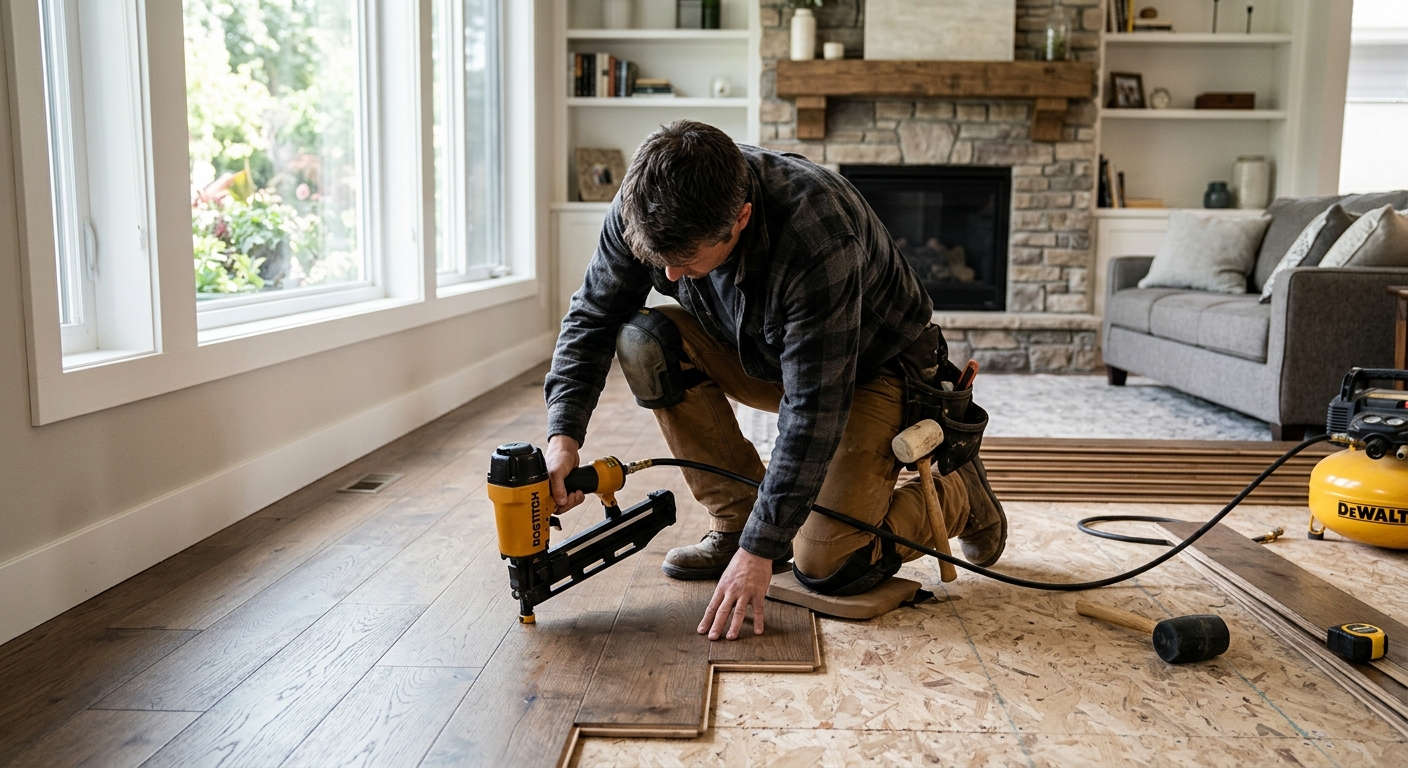
Flooring options and costs in Hillcrest Village
Flooring in Hillcrest Village is all about picking the right material for a home’s moisture swings, basement risk, and the realities of Toronto-area renovation labour. With a population of 16,934 (Statistics Canada, 2021 Census), the area has plenty of contractor capacity—but prices still track the higher wage environment and busy renovation calendar across the GTA. One reason homeowner quotes can vary is the age of many local homes; a lot of Toronto-area housing was built well before today’s modern air-sealing practices, so expect more subfloor levelling, plywood repair, or moisture mitigation than you might in newer subdivisions. In many projects, that prep can add roughly $1–$4 per sq ft before you even buy finished flooring.
Toronto’s climate drives the rest of the cost equation: you can see wide indoor humidity swings across seasons, and even well-maintained houses can experience moisture movement through slab edges and older subfloors. That’s why we usually steer clients toward engineered hardwood or luxury vinyl plank (LVP) in condos and newer infill builds, while solid hardwood—though beautiful—needs tighter moisture control and is risky over concrete or in basements. If you’re in an area like the Yonge/Sheppard corridor-adjacent pockets near local commercial nodes, we also see more turnover and multi-unit work, which increases demand for sound-conscious underlay and dimensional-stable materials.
Below is a practical cost comparison to help you budget for materials and typical installs, and to understand why “same room, different product” can still land at different totals.
| Type |
Best Room |
Moisture Resistance |
Lifespan |
Price per sq ft |
| Solid hardwood (nail-down, above grade only) |
Living / dining (above grade) |
Low–moderate (sensitive to humidity swings) |
25–60 years |
$9–$18 |
| Engineered hardwood (float or glue, above + on-grade) |
Living / dining, hallways (above + on-grade) |
Moderate–high (more stable in humidity) |
20–40 years |
$10–$17 |
| Laminate (click-lock, above-grade) |
Bedrooms, living rooms (above grade) |
Low–moderate (not for below-grade flooding) |
10–25 years |
$4–$9 |
| Luxury vinyl plank / LVP (waterproof, any level) |
Kitchen, main floor, basement (finished) |
High (waterproof core) |
15–25 years |
$5–$12 |
| Porcelain / ceramic tile |
Kitchen, bathrooms, entryways |
Very high (tolerates moisture) |
30–50 years |
$12–$25 |
| Carpet (broadloom or modular tile) |
Master bedroom, stairs/landing |
Moderate (avoid long-term dampness) |
7–15 years |
$5–$11 |
Prices are estimates only and vary by project scope, site access and material selection.
What affects the price of flooring in Hillcrest Village
In Hillcrest Village and the broader Toronto area, it’s common to see the same flooring idea priced 30–50% apart from one quote to another—even when the finish looks similar. The difference is usually not the “floor” itself; it’s the prep and the installation plan. Toronto-area homes often face indoor humidity swings and, in older properties, below-surface moisture or uneven subfloors that require levelling, plywood replacement, or moisture mitigation. If one contractor includes that prep and the other only prices a clean, flat surface, the “apples-to-apples” comparison breaks down fast.
Technically, solid hardwood expands and contracts with indoor humidity, so it cannot be glued or floated over concrete, and it performs poorly in basements or over slabs that show moisture. In contrast, engineered hardwood and LVP are built for higher humidity tolerance and can handle many on-grade/below-grade situations with the right underlay or system. In colder periods and new custom homes that add radiant floor heating, owners often need products that tolerate heat cycling; that typically steers choices toward engineered wood, tile, and certain vinyl systems.
Here are concrete Hillcrest Village examples that shift your budget: (1) a 500 sq ft main floor with minor lippage or low spots may add about $1–$3 per sq ft for levelling and fast patching, but a deeper plywood replacement can push the same job closer to $3–$4 per sq ft; (2) if you remove old carpet tack strips and haul away bulky underpad, that can add hours and disposal fees; (3) upgrading from laminate in the $4–$9 range to engineered hardwood in the $10–$17 range is often justified when moisture risk and longevity matter—especially when basements or slab edges are part of the plan.
Use these factors to interpret quotes: the “cheapest” material can become costlier once prep and risk-reduction are included.
| Price Factor |
Why It Matters |
Cost Impact |
| Room area in sq ft |
Directly affects material quantity and labour hours |
Low to high (bigger homes = more waste and time) |
| Subfloor condition — levelling or repair needed before install |
Toronto-area older slabs/subfloors often need flattening or replacement |
Typical add: $1–$4 per sq ft depending on scope |
| Moisture / below-grade install — rules out solid hardwood |
Humidity swings and below-grade vapour require stable products |
Can shift you from $9–$18 solid to engineered/LVP |
| Material choice — solid vs. engineered vs. LVP vs. tile |
Different price bands and different underlayment systems |
Solid: $9–$18; LVP/laminate: $4–$12; tile: $12–$25 |
| Removal and disposal of existing flooring |
Tack strips, glue, underlay, and drywall cuts take time |
Often adds a meaningful line item (time + dump fees) |
| Stair nosing / transitions — charged per step or per linear foot |
Transitions add labour, trim, and material complexity |
Small per-piece, but totals add up quickly |
| Radiant heat compatibility — limits material options |
Heat cycling affects expansion and adhesive/underlay selection |
May require specific engineered products (higher material cost) |
| Installation method — float vs. glue-down vs. nail-down |
Different prep, adhesives, and labour intensity |
Glue-down can cost more than float in many cases |
Permits & regulations in Ontario
In Ontario, installing a basic floor covering itself typically does not require a building permit—most flooring work is considered a finish renovation. That said, some associated tasks can trigger permits depending on what’s being done. If your project includes in-floor radiant heating work that ties into electrical components, or any electrical modifications for thermostats and circuits, an electrical permit may be required. Similarly, if the job includes significant structural changes to the subfloor (for example, replacing major structural framing elements), that may fall into the category of work that needs permits or inspections.
In condominiums across the GTA, the bigger “restriction” is often not municipal permitting—it’s building policy. Many corporations require specific underlay choices for sound transmission and may limit hard flooring in upper units due to noise impact. Before you install hardwood or tile above grade in a multi-unit building, you should review the condo declaration and the corporation’s flooring policies, and request written approval if required. Always keep that approval with your job file.
To verify a contractor in Hillcrest Village, follow a simple step-by-step approach: (1) confirm their Ontario business info and credentials via the appropriate online registry resources; (2) ask for a current certificate of liability insurance and ensure the coverage is active for your job dates; (3) ask for proof of WSIB/WCB clearance or coverage (and confirm the account is good standing); (4) request the clearance letter in writing and keep copies for your records. This protects you if there’s an injury on-site or damage during installation.
Best flooring for each room in your Hillcrest Village home
Choosing flooring by room is especially important in Hillcrest Village because Toronto-area homes routinely experience indoor humidity swings, and many properties have moisture challenges around older subfloors, slab edges, and basements. The right material can also improve comfort and reduce the risk of cupping, gapping, or squeaks. For main living spaces (living/dining), most homeowners get the best balance from engineered hardwood or high-quality laminate: they look warm, install cleanly, and handle everyday moisture variation better than solid hardwood.
In bedrooms, you can prioritize comfort and quiet. Carpet often wins for underfoot comfort and sound absorption, particularly in master bedrooms or upper floors. For kitchens, choose luxury vinyl plank (LVP) or large-format porcelain tile. LVP is waterproof and easy to maintain, and tile is the go-to where you expect spills, water, and frequent cleaning. In finished basements, LVP is usually the clear winner: it handles moisture vapour conditions and below-grade installs far better than solid wood and most laminate.
Bathrooms should be porcelain or ceramic tile only. If your home uses radiant floor heating (increasing in newer builds across the Toronto area), that tends to pair best with engineered wood, tile, and certain vinyl systems. Traditional solid hardwood is often a poor fit because it can be too sensitive to heat-driven expansion and humidity shifts.
Budget justification example: if you’re comparing laminate at $4–$9 versus engineered hardwood at $10–$17, the higher material cost can be worth it when your home’s humidity varies seasonally—especially if you want a longer lifespan and less risk of movement over time.
| Room |
Best Material |
Why |
Moisture Risk |
Price Band per sq ft |
| Living / dining room |
Engineered hardwood |
Warm look with better stability during humidity swings |
Low to moderate (depends on HVAC and season) |
$10–$17 |
| Master bedroom |
Carpet or engineered hardwood |
Comfort and sound absorption; engineered if you prefer hard surface |
Low |
$5–$11 |
| Secondary bedrooms |
Laminate or carpet |
Good value; carpet reduces noise and improves comfort |
Low |
$4–$9 |
| Kitchen |
Luxury vinyl plank (LVP) |
Waterproof performance for spills and easy daily cleaning |
Moderate (spills and sink/door exposure) |
$5–$12 |
| Basement (finished) |
Luxury vinyl plank (LVP) |
Designed for below-grade installs where moisture vapour is common |
High |
$5–$12 |
| Bathroom |
Porcelain / ceramic tile |
Best-in-class moisture tolerance and long-term cleanability |
High |
$12–$25 |
How to choose a flooring contractor in Hillcrest Village
When you’re hiring a flooring contractor in Hillcrest Village, your goal is to confirm they can manage both materials and the job-specific risks that Toronto-area homes commonly face. Start by verifying Ontario licensing and proof of coverage: request their liability insurance certificate (active dates and jobsite coverage) and ask for their WSIB/WCB clearance or proof they carry appropriate workers’ coverage. Most reputable companies can provide this immediately—if they hesitate, that’s a signal to move on.
Then get 2–3 itemised written quotes instead of a single lump sum. A proper quote separates labour and materials, includes underlay and adhesives (where needed), and explains what’s excluded—especially removal, subfloor patching, and transitions. Ask explicitly whether the scope includes permit pull (only if applicable for the electrical/radiant work), disposal of old flooring, and any moisture mitigation steps. Flooring projects are where “scope creep” happens fastest, and a tight scope prevents budget surprises.
Check warranty details too: confirm the workmanship warranty length (and what triggers it), the manufacturer product warranty terms, and whether the warranty is transferable to you. Finally, keep payment safe: never pay more than 10–15% upfront. Use a holdback until the job is complete and you’ve confirmed the floor is flat, transitions align, and any punch-list items are finished. Get the start date and realistic completion estimate in writing so scheduling doesn’t drift.
- Ask for proof of liability insurance and WSIB/WCB clearance in writing.
- Request a licence/credential reference and confirm it matches the company name on the contract.
- Get 2–3 quotes with labour and materials broken out separately.
- Confirm whether subfloor levelling and plywood replacement are included or priced as extras.
- Ask how they assess moisture (especially near slab edges and basements).
- Verify underlay/adhesive selection matches your product and room conditions (humid vs dry).
- Ensure removal and disposal of existing flooring is included if you want it handled.
- Have them list transitions, stair nosing, and mouldings per step/linear foot (not vague allowances).
- Get a written demolition plan to protect walls/door frames during removal.
- Review timeline: start date, daily work hours, and a completion estimate in writing.
- Clarify warranty coverage: workmanship duration, product warranty, and transferability.
- Set payment milestones: 10–15% deposit max, holdback until completion.
Concrete red flags in Hillcrest Village: (1) quoting with no site visit or no discussion of subfloor condition; (2) refusing to provide insurance/WSIB documents; (3) using vague allowances like “$X for underlay” without specifying the exact product; (4) lump-sum quotes that don’t address removal/disposal and transitions; and (5) pushing large upfront payments or avoiding a written contract with scope and timeline.
Frequently asked questions — flooring in Hillcrest Village
Can I install hardwood over concrete?
In Ontario homes around Hillcrest Village, you can sometimes place engineered hardwood over concrete, but you need the right system and prep. Traditional solid hardwood is the one that most often can’t go directly over concrete; it typically requires an above-grade, moisture-controlled environment and is usually nail-down. If your slab is on-grade or has moisture vapour, that’s where engineered wood (with appropriate underlayment or glue-down method) is usually the safer direction.
Before anyone installs, ask the contractor how they’ll manage moisture and flatness: they should discuss subfloor testing, the plan for high/low spots, and what underlayment is compatible. Also factor in prep costs—older Toronto-area floors often need levelling or patching, which can add about $1–$4 per sq ft. If you’re comparing budgets, solid hardwood often starts around $9–$18, but the “hidden” prep risk over concrete can make engineered a better value in practice.
How long does flooring installation take?
Installation time in Hillcrest Village depends on room count, square footage, and—most importantly—subfloor prep. A clean, flat subfloor with straightforward cuts and minimal transitions can move faster. In many Toronto-area renovation jobs, expect extra time for levelling compound, plywood repair, or moisture mitigation, which adds days even when the finished flooring is mid-range.
As a general expectation, single-room work (like a bedroom) can take about 1–3 days once prep is complete. Main-floor projects are often longer, especially with removal, stair nosing, and multiple room transitions. If you’re also dealing with old adhesive or underlay removal, add time for that scope.
Your contractor should give you a written schedule with a start date and completion estimate. If they can’t explain what steps happen before day one (demolition, levelling, acclimation where required), that’s a sign the timeline may be unrealistic. And if you’re paying in the $4–$9 range for laminate, don’t assume it’s faster—prep still drives the calendar.
What flooring works with radiant heat?
Radiant floor heating is increasingly common in new builds across the Toronto region, and Ontario homeowners often want finishes that tolerate heat cycling without dimensional surprises. In Hillcrest Village, the best matches are typically tile (porcelain/ceramic) and many approved engineered hardwood products, plus certain LVP systems that are specifically rated for radiant applications.
Solid hardwood is usually more restrictive. The heat can drive expansion and contraction that’s harder to manage than in standard above-grade conditions, and it’s also more sensitive to moisture/humidity swings. Laminate can work in some radiant setups, but compatibility depends heavily on the product rating and the underlayment/installation method.
Before installation, ask for the exact product’s radiant heat compatibility statement in writing. Also confirm the contractor’s installation method (glue-down vs float) and whether acclimation and subfloor flattening are included. This is one reason quotes can differ by 30–50% across Toronto: the “right” radiant-rated materials may cost more, but they reduce long-term movement complaints.
Engineered vs solid hardwood — what's the difference?
Engineered and solid hardwood can look identical at the surface, but they behave differently in Ontario’s humidity swings. Solid hardwood is one uniform piece of wood and typically expands/contracts more across seasonal humidity changes, which is why it’s usually limited to above-grade installs and avoids basements and concrete slabs.
Engineered hardwood has a plywood or composite core with a wood wear layer on top. That layered construction improves dimensional stability, so it’s generally more forgiving for on-grade conditions and is often the safer choice when your home’s moisture profile is less predictable.
In Hillcrest Village, you’ll also see a practical value difference. Solid hardwood commonly lands in the $9–$18 band, while engineered often sits close to $10–$17, but the “total install” can swing based on subfloor prep and whether concrete or higher-humidity areas are involved. If your project touches basements or concrete, engineered hardwood usually reduces risk compared with solid.
Do I need to level my subfloor first?
Most of the time in Hillcrest Village, yes—your subfloor needs to be flat and sound before the final flooring goes down. Even if the room “looks fine,” small high/low spots can cause visible gaps, squeaks, or uneven wear, especially with click-lock laminate and floating engineered floors. For glue-down systems, unevenness can break bond performance.
Toronto-area homes from the 1960s–1990s often need attention: plywood replacement, patching, or levelling compound to address uneven areas and prevent future movement. Typical add-ons can run about $1–$4 per sq ft depending on how far you have to go.
Ask your contractor how they’ll measure flatness (straightedge/checking), what product they use for levelling, and whether subfloor repair is included or billed separately. This is also where quotes can diverge by 30–50%: one contractor may include levelling in the baseline, and another may only price flooring “on top” of whatever is there.
What's the most durable flooring for pets and kids?
For pets and kids in Ontario, the “most durable” choice depends on where you install it and how much moisture risk you have. In Hillcrest Village basements and main floors that get spills, luxury vinyl plank (LVP) is usually the top performer: it’s waterproof, stands up well to everyday impacts, and is much easier to clean after accidents than hardwood or laminate. Typical LVP pricing often falls around $5–$12 per sq ft depending on wear layer and installation system.
If you want a natural look with strong performance above grade, engineered hardwood can be durable, but it still isn’t the same as a fully waterproof core—so active spill management matters. Tile is also extremely durable for wet areas, but it’s harder underfoot, which some families prefer to avoid in living spaces.
For any option, ask about scratch resistance and wear layer thickness, and ensure the contractor installs transitions and underlay correctly. Also consider underlay choices that reduce noise in condos—Ontario buildings often have sound rules, and your board may require specific underlay to meet impact expectations.