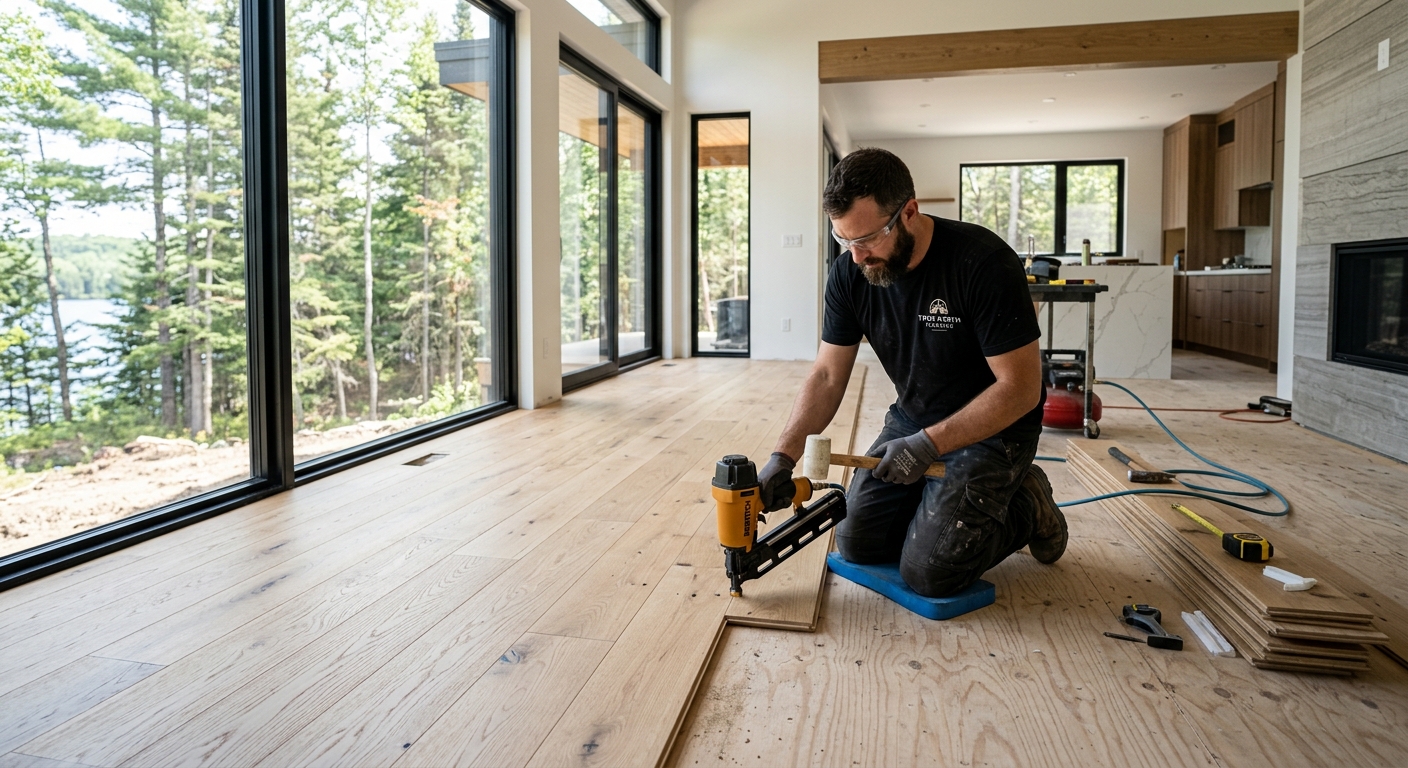
Flooring options and costs in Orillia
Orillia homeowners typically choose flooring with an eye on both comfort and moisture, especially because homes here often sit through real seasonal swings. In fact, about 58.0% of Orillia area dwellings were built before 1981 (Statistics Canada, 2021 Census), and that older housing stock frequently means the subfloor isn’t perfectly flat. When a contractor needs to level or repair before installation, your “same floor, different house” situation can add noticeable cost. Another local factor is how many households are owner-occupied—61.2% of households own (Statistics Canada, 2021 Census)—which usually translates into more full-room projects and better planning for long service life.
In the Kitchener–Waterloo–Barrie economic region, humidity rises through summer and can leave basements more temperamental in shoulder seasons. That matters because solid hardwood expands and contracts with humidity, and it also should not be installed over concrete or in below-grade spaces. Engineered hardwood and luxury vinyl plank (LVP) are more dimensionally stable, so they’re often priced and specified with less risk for callbacks. Radiant heat is also increasingly common in Ontario; it tends to steer buyers toward radiant-compatible engineered wood, quality laminate, LVP, or tile rather than solid hardwood.
Trades see especially high demand around central Orillia and the areas with more older homes—near Couchiching Beach and the downtown core—where renovations blend older foundations with modern expectations for easy cleaning and durability. Below is a practical cost comparison to help you line up quotes before you choose a direction for your space.
| Type |
Best Room |
Moisture Resistance |
Lifespan |
Price per sq ft |
| Solid hardwood (nail-down, above grade only) |
Living rooms, dining rooms (dry, above-grade) |
Low to moderate (humidity-sensitive) |
25–60 years |
$9, – $18, |
| Engineered hardwood (float or glue, above + on-grade) |
Main floors, bedrooms, hallways |
Moderate to high (more stable) |
20–35 years |
$10, – $16, |
| Laminate (click-lock, above-grade) |
Secondary bedrooms, rec rooms (above-grade) |
Low to moderate (not for basements) |
10–25 years |
$4, – $8, |
| Luxury vinyl plank / LVP (waterproof, any level) |
Kitchens, bathrooms nearby, finished basements |
High (waterproof core) |
15–25 years |
$5, – $12, |
| Porcelain / ceramic tile |
Bathrooms, kitchens, entryways |
Very high (water tolerant) |
30–50 years |
$8, – $20, |
| Carpet (broadloom or modular tile) |
Bedrooms, stairs for comfort |
Low (needs dry conditions) |
7–15 years |
$4, – $9, |
Prices are estimates only and vary by project scope, site access and material selection.
What affects the price of flooring in Orillia
In Orillia, two quotes for the “same” flooring can differ by 30–50% across the Kitchener–Waterloo–Barrie region and even within Ontario because the real variable is how much prep work and finishing the contractor must do. Older homes built before 1981 are common (Statistics Canada, 2021 Census), and that often means the existing subfloor is uneven or damaged. When levelling is required, the installer may need patching, underlayment changes, or self‑levelling—especially to make click‑together laminates and LVP look crisp and stay locked.
Technical conditions drive cost here: Kitchener–Waterloo–Barrie experiences summer humidity and winter dry periods, which affects materials differently. Solid hardwood expands and contracts with humidity and also isn’t a good match for below-grade concrete. Engineered hardwood and LVP tolerate humidity and below-grade moisture far better when paired with the correct vapour barrier/subfloor system. In colder Ontario homes, radiant heat cycles are another cost driver—solid hardwood often isn’t recommended with aggressive radiant systems, and not all laminate or adhesives are compatible.
Concrete examples that show why your quote changes in Orillia: (1) a basement “finished” area over a concrete slab can add vapour barrier and subfloor labour—often making LVP cost-effective even if materials look similar to laminate; (2) if your floor is out of flat by more than a small tolerance, tile and LVP may require additional levelling to prevent lippage or gapping; (3) removal/disposal of older flooring (especially glued-down material) can add labour that pushes your total toward the higher end of the $9, – $18, hardwood band or the $8, – $20, tile band.
| Price Factor |
Why It Matters |
Cost Impact |
| Room area in sq ft |
Larger areas increase material quantity, cutting, and time on-site |
Often the biggest driver; efficiencies may reduce per-sq-ft |
| Subfloor condition |
Uneven or damaged substrates require levelling/repairs first |
Commonly adds $1–$4 per sq ft in older homes |
| Moisture / below-grade install |
Solid hardwood is typically ruled out over basements and concrete |
Can shift you to engineered hardwood or LVP to control risk |
| Material choice |
Solid vs. engineered vs. LVP vs. tile changes stability and install method |
Hardwood and tile run higher than laminate/vinyl |
| Removal and disposal of existing flooring |
Tearing out, hauling, and prep time add labour and waste costs |
Can add a meaningful surcharge depending on thickness and glue |
| Stair nosing / transitions |
Per-step or per-linear-foot detailing takes extra time and labour |
Often adds to the total more than homeowners expect |
| Radiant heat compatibility |
Temperature cycles limit material options and require correct underlay |
May increase materials cost and affect selection |
| Installation method |
Float vs. glue-down vs. nail-down impacts labour, adhesives, and prep |
Can change labour line items by several dollars per sq ft |
Permits & regulations in Ontario
In Ontario, the flooring installation itself typically does not require a building permit. However, certain associated work can trigger permits—especially anything involving electrical systems or structural changes. If your project includes in-floor heating electrical components, adjustments to wiring, or new circuits, you may need electrical permits and sign-off through the proper channels. Similarly, if the job involves significant structural subfloor repair beyond simple patching (for example, framing changes for load support), the scope may require additional approvals depending on how it’s done.
For condominiums, the rules are often more restrictive than for detached homes. Even when a permit isn’t required, the condo corporation may require specific underlay for sound transmission, and it may limit hard flooring in upper units due to impact sound ratings (such as STC/IIC). Always review your condo declaration and request any board approval in writing before installing hardwood or tile on upper floors—this avoids rework and disputes after the fact.
To verify your contractor is set up properly in Orillia and across Ontario, do three checks: (1) confirm licensing/provable credentials where applicable for their trade scope, (2) request a certificate of insurance (liability) naming you as an additional insured where reasonable, and (3) verify WSIB/WCB coverage through the contractor’s proof documentation. Ask for the current clearance letter or coverage proof before work starts, and keep a copy with your contract.
Best flooring for each room in your Orillia home
Choosing the right flooring for each room in an Orillia home is mostly about matching moisture exposure, traffic, and comfort. In the living and dining areas, engineered hardwood or a high-quality laminate often hits the sweet spot: they bring warmth underfoot while being more forgiving of humidity swings than solid wood. For bedrooms, carpet is still a strong choice in Ontario winters because it stays comfortable, reduces sound, and helps with insulation; alternatively, engineered hardwood works well if you’re aiming for a cleaner look.
In kitchens, LVP is a top pick because spills and splash zones are real, and LVP’s waterproof core makes maintenance straightforward. If you want maximum durability and a “set it and forget it” finish, large-format porcelain or ceramic tile is also excellent—just remember that tile requires a very well-prepared flat surface. Basements are where decisions get most sensitive in this region: fully waterproof LVP is usually the clear winner over concrete slabs because it tolerates moisture vapour better than solid hardwood and most laminate. Bathrooms should be porcelain or ceramic tile only, because they’re designed to handle wet conditions.
For radiant heat areas, verify the specific product’s radiant compatibility—radiant systems are increasingly common in Ontario new construction and renovations. Where some solid hardwood installs can be risky with temperature cycles, engineered wood, laminate (rated for radiant), LVP, and many tiles are often the safer selections. As a practical cost example: in a typical room, switching from laminate around the $4, – $8, band to LVP around the $5, – $12, band can be justified in a basement-frequented space because you reduce moisture-related failures and avoid expensive replacement.
| Room |
Best Material |
Why |
Moisture Risk |
Price Band per sq ft |
| Living / dining room |
Engineered hardwood |
Warm look, stable through humidity swings, good everyday durability |
Low (above-grade, normal household conditions) |
$10, – $16, |
| Master bedroom |
Carpet or engineered hardwood |
Carpet adds comfort and sound control; engineered wood stays cleaner |
Low to moderate (depends on basement adjacency and ventilation) |
$4, – $9, |
| Secondary bedrooms |
Laminate (rated for quality) or engineered hardwood |
Laminate handles day-to-day traffic well when the subfloor is flat |
Low (above-grade) |
$4, – $12, |
| Kitchen |
Luxury vinyl plank (LVP) or porcelain tile |
Moisture and spill tolerance, easier cleaning, and better stain resistance |
Moderate to high (spills and sink/door splash) |
$8, – $20, |
| Basement (finished) |
Luxury vinyl plank (waterproof) |
Best match for concrete slabs and humidity; low replacement risk |
High (below-grade moisture vapour potential) |
$5, – $12, |
| Bathroom |
Porcelain / ceramic tile |
Designed for wet environments and long-term wear |
Very high (direct water exposure) |
$8, – $20, |
How to choose a flooring contractor in Orillia
Start by verifying coverage and eligibility for Ontario work. Ask for proof of liability insurance (a current certificate of insurance) so you’re protected if something is damaged or an injury occurs. For coverage of workers, request proof of WSIB/WCB status (or the contractor’s clearance letter/coverage verification). This matters in Orillia because jobs often include subfloor prep, stair work, and dust-producing removal that increases risk if the crew isn’t properly insured.
Next, get 2–3 itemised written quotes—labour and materials separated line-by-line, not a lump sum. A good quote clearly lists removal/disposal, subfloor prep (level-lift, patching, underlay, vapour barrier where required), transitions/stair nosing, and finish details. Read the scope carefully: confirm whether permits are included if needed for any electrical/radiant work, whether disposal is included, and what’s excluded (baseboards, drywall touch-ups, moving furniture, or repairs beyond cosmetic patching).
Warranty should be spelled out: workmanship warranty length, product/manufacturer warranty terms, and whether the warranty is transferable to future owners. For payment, never pay more than 10–15% upfront; hold back part of the total until the job is fully complete and you’ve verified transitions, edges, and clean-up. Finally, get a written start date and completion estimate; in Ontario, weather and material lead times can shift schedules, so it should be planned.
- Ask for WSIB/WCB proof and confirm it’s active before work begins.
- Request liability insurance certificate and confirm coverage limits are reasonable for renovation work.
- Get a licence/credential summary relevant to their scope (and confirm it’s current).
- Require an itemised quote (materials vs labour vs prep vs disposal).
- Confirm subfloor flatness expectations and how they measure it.
- Make sure moisture protection details are written (vapour barrier/underlay for below-grade).
- Check radiant compatibility statements for engineered wood/LVP/laminate if you have in-floor heat.
- Ask who supplies underlayment, fasteners, adhesives, and transition mouldings.
- Clarify warranty: workmanship, manufacturer, and transferability.
- Use a staged payment schedule (10–15% upfront max; holdback for completion).
- Confirm jobsite protection and dust control plan.
- Require a written start and completion timeline, including lead times.
Red flags I see in Orillia: (1) quotes that ignore subfloor levelling/repairs even when the existing floor is uneven, (2) no written scope for moisture vapour barriers in basement or slab areas, (3) refusing to provide proof of insurance/WSIB/WCB, (4) asking for large upfront payments, and (5) vague warranties (“we stand behind it”) without dates, terms, and documentation.
Frequently asked questions — flooring in Orillia
What is the best flooring for a high-traffic area in Orillia?
For high-traffic areas in Orillia (entries, hallways, main living paths), the safest “long game” choices are LVP and quality engineered hardwood—provided the subfloor prep is done properly. LVP is popular because it tolerates moisture and everyday wear; it’s also a practical fit for homes with humidity swings common across the Kitchener–Waterloo–Barrie region. If you’re staying above-grade and want a natural look, engineered hardwood offers stability better than solid wood in humidity. If you’re comparing budgets, LVP often sits around the $5, – $12, per sq ft band, while solid hardwood tends to be higher-risk in basements and usually starts near the upper $9, – $18, band for above-grade installs. Always verify product wear rating, not just the material name.
How do I prepare my subfloor before new flooring?
Subfloor prep is where good floors are won or lost in Ontario. In Orillia homes—especially those built before 1981—subfloors often need levelling, repairs, or both (Statistics Canada, 2021 Census). For best results, the contractor should (1) remove existing flooring and any loose material/old adhesive residue, (2) inspect for soft spots, squeaks, and moisture issues, (3) check flatness with straight edges/measurement tools, and (4) perform patching or self‑levelling as required. Above-grade laminate and floating floors need a very flat substrate to prevent clicking points from stressing. For basements over concrete, correct vapour barrier and an appropriate underlay/subfloor system are critical. Expect levelling costs to fall in the $1–$4 per sq ft range in older homes when the surface isn’t ready.
Is cork or bamboo flooring a good choice in Orillia?
Cork can be a good comfort option in dry, above-grade rooms because it’s naturally resilient and insulating. However, cork is still vulnerable to prolonged moisture, so it’s not a basement-first choice—especially given below-grade moisture vapour concerns in the region. Bamboo can work as a hardwood-look option, but you’ll want to verify how it’s constructed (engineered vs solid) and the manufacturer’s humidity/radiant compatibility instructions. In many Orillia renovation scenarios, homeowners get better results by choosing engineered hardwood or LVP for stability and easier moisture management. Price-wise, cork/bamboo can land across the same general range as hardwood depending on quality and install method, which is why it’s important to prioritize stability over name recognition. If your home has in-floor radiant heat, ensure the product is explicitly rated for it before committing.
What is the difference between floating and glued-down flooring?
Floating floors “click” together and do not get fastened to the subfloor; they sit over an underlay, allowing slight movement across temperature and humidity cycles. Glued-down flooring is bonded directly to the subfloor with an approved adhesive, which can improve stability and sound feel, but it makes subfloor moisture and preparation even more critical. In Orillia’s climate—dry winters and humid summers—floating engineered/laminate can handle seasonal changes well when the installation system is correct and the underlay is specified. Glued-down installations typically demand stricter moisture conditions and more careful surface prep, especially over concrete or in older homes where subfloors need repair. If you’re considering LVP, many are designed to be installed as floats; for solid hardwood, gluing is generally not the default for Ontario basements, and below-grade installs are usually avoided.
What flooring holds up best to pets in a Orillia home?
For pets, the best-performing flooring choices in Orillia are typically waterproof LVP and porcelain/ceramic tile. LVP is forgiving with typical pet accidents and easy cleanup, and it can handle the humidity swings better than solid hardwood. Tile is extremely durable against claws and is also easy to sanitize. Carpet can be comfortable, but in homes with pets it needs careful stain management and can trap odours if moisture gets into the padding—especially if any rooms have basement-adjacent moisture issues. If you’re budgeting, consider LVP around the $5, – $12, band for a basement or busy hallway, while tile may run closer to the $8, – $20, band. For any material, plan for correct underlay and ensure nails/squeaks are fixed before install to avoid movement and premature wear.
How do I fix squeaky floors in my Orillia home?
Squeaks are usually caused by movement between subfloor layers, loose fasteners, or joists shifting slightly—not by the finished flooring alone. In Orillia, older homes (often built before 1981) commonly have subfloor fastening and alignment issues that show up over time (Statistics Canada, 2021 Census). The first step is diagnosing where the squeak happens: press down near the squeak location, compare sound locations, and check for movement from above. The most effective fix is usually to access the subfloor/joists from below (if there’s a basement) or remove a small section to re-screw/secure the panels properly. Avoid “covering it up” without addressing the movement—otherwise new floors (especially laminate/LVP click joints) can shift and wear faster. If your squeaks are over radiant-heated areas or in slab-on-grade sections, tell your contractor first so they can choose safe methods and protect the system.