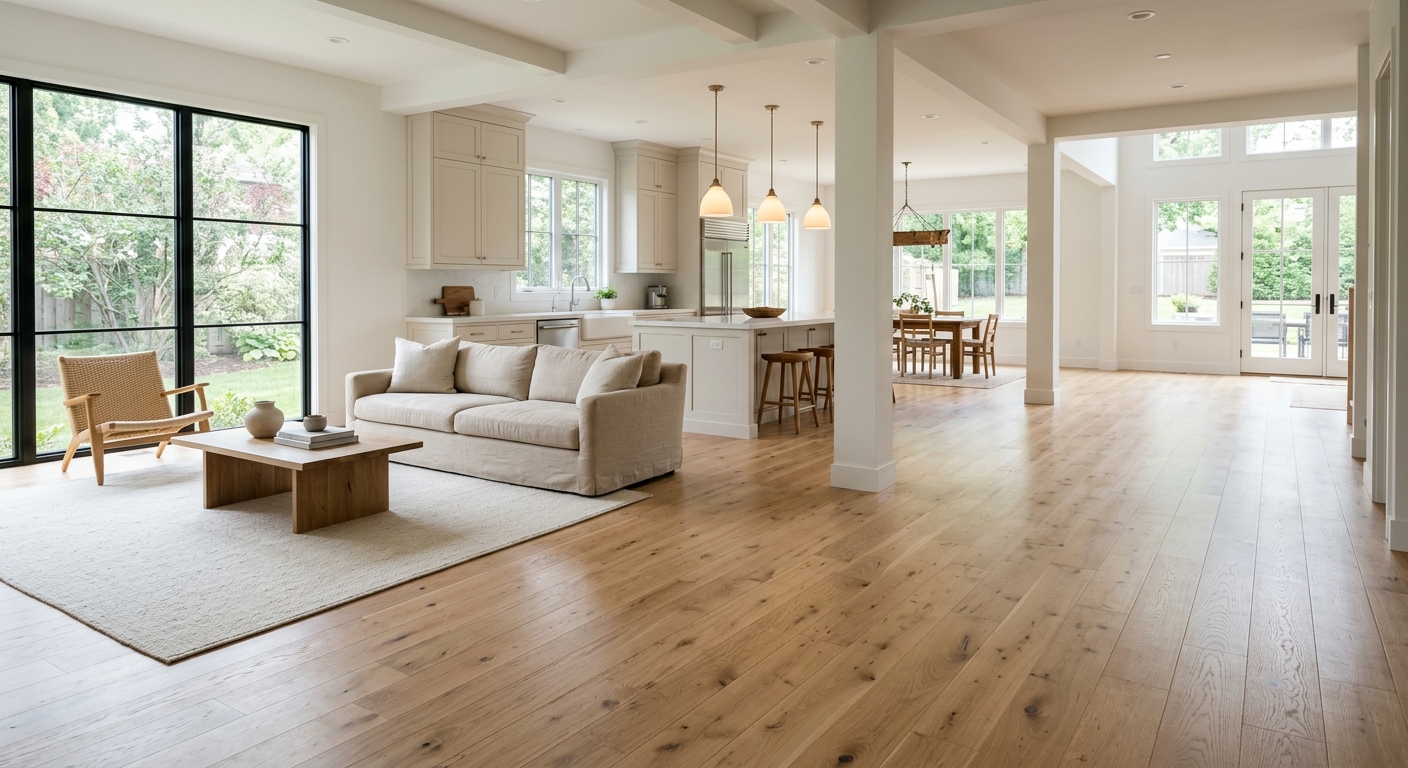
Flooring options and costs in Woodstock
Woodstock homeowners usually face a few recurring flooring challenges: mixed-humidity winters, periodic indoor dryness, and occasional basement dampness in older houses. With 50.4% of homes built before 1981 (Statistics Canada, 2021 Census), many projects start with patching, levelling, or replacing uneven underlayment so the new surface sits flat and won’t telegraph dips. That “prep first” work is a real cost driver, and it’s why two quotes for the same room size can differ even when the finish looks similar at the showroom.
In the London-area mixed-humidity, cold-climate zone, temperature swings and moisture vapour move through slabs and basements. Solid hardwood can expand and contract with seasonal humidity and should not be installed below grade or directly over concrete, which often adds expense (and limitations) when you want a basement-finished floor. For many Woodstock basements and slab-on-grade areas, contractors steer clients toward engineered hardwood or luxury vinyl plank (LVP) because they’re more dimensionally stable. LVP also has an advantage where humidity fluctuates, and it can be installed over properly prepared subfloors with the right underlayment and moisture-control approach.
Trade demand is especially steady in Eastside and the older core near the downtown—both areas tend to have more renovation work, older planks, and subfloor repairs before new finishes go down. Once those prep steps are scoped, it’s easier to compare realistic material-and-install cost ranges, starting with the options below.
| Type |
Best Room |
Moisture Resistance |
Lifespan |
Price per sq ft |
Price Range |
| Solid hardwood (nail-down, above grade only) |
Living room, dining room |
Low to moderate (humidity sensitive) |
25–50 years |
$9–$15 |
$9,000–$15,000 |
| Engineered hardwood (float or glue, above + on-grade) |
Living areas, bedrooms |
Moderate to high (more stable) |
20–40 years |
$10–$17 |
$10,000–$17,000 |
| Laminate (click-lock, above-grade) |
Bedrooms, hallways |
Low to moderate (seams can fail if wet) |
10–25 years |
$4–$9 |
$4,000–$9,000 |
| Luxury vinyl plank / LVP (waterproof, any level) |
Basements, kitchens, main floors |
High to waterproof (with correct install) |
15–25 years |
$5–$11 |
$5,000–$11,000 |
| Porcelain / ceramic tile |
Bathrooms, kitchens, entry |
High (waterproof surface) |
30–50+ years |
$12–$25 |
$12,000–$25,000 |
| Carpet (broadloom or modular tile) |
Bedrooms, stairs |
Low (needs protection from moisture) |
8–15 years |
$4–$8 |
$4,000–$8,000 |
Prices are estimates only and vary by project scope, site access and material selection.
What affects the price of flooring in Woodstock
In Woodstock and across Ontario, the same “average room” flooring job can swing 30–50% between quotes because preparation and moisture management are often where the hidden costs live. Even when the finish price looks close, contractors price differently for subfloor repair, underlayment, levelling compounds, vapour-control layers, and transitions. On older homes (and with 57.5% of dwellings being single-detached in the area profile), it’s common to discover plank movement, crowned joists, or patchwork from prior renovations that affects labour time before any flooring is installed.
Technically, indoor humidity swings are the key driver in Southwestern Ontario. Solid hardwood expands and contracts with seasonal changes, so it cannot be glued or floated over concrete and performs poorly in basements where moisture vapour pressure is higher. That’s why solid usually carries lower material cost than engineered, but can still be more expensive overall if you need strict above-grade conditions, acclimation, and careful moisture control. Engineered wood and LVP handle humidity and below-grade applications far better, which can reduce risk-related labour and warranty issues. Colder winters also mean many homeowners consider radiant heat; that usually rules out most traditional solid hardwood and some laminate options, shifting selections toward radiant-rated engineered wood, LVP, tile, and some laminates.
Concrete Woodstock examples: a basement conversion often needs a moisture package plus an underlayment system, which can add roughly $1–$4 per sq ft to prep. If your main floor has out-of-flat subfloor issues from older construction (over 50% of homes are pre-1981 in the local profile), levelling compounds and labour can narrow the gap between “budget” laminate at the $4–$9 band and mid-range engineered or LVP once everything is done right. Where you start with a flat, dry slab and clean joists, you might stay nearer to laminate or LVP bands; where you need levelling and moisture barriers, engineered and LVP often end up being the smarter, longer-lasting value.
| Price Factor |
Why It Matters |
Cost Impact |
| Room area in sq ft |
Directly drives material quantity, waste, and labour hours |
Major—often the biggest variable |
| Subfloor condition |
Levelling or repair may be required before install |
Medium to major (commonly adds $1–$4/sq ft) |
| Moisture / below-grade install |
Solid wood is typically not suitable; vapour control becomes critical |
Major (can add barrier and prep labour) |
| Material choice |
Solid, engineered, LVP, and tile price differently and install differently |
Major (tile typically higher than laminate/LVP) |
| Removal and disposal of existing flooring |
Old flooring, adhesives, and underlayments take time and disposal fees |
Medium (varies by adhesive type and thickness) |
| Stair nosing / transitions |
Transitions and stair edging are labour-intensive and material-driven |
Medium (priced per step or linear foot) |
| Radiant heat compatibility |
Not all materials tolerate heat cycles; product rating affects cost |
Medium (selection limits can raise materials cost) |
| Installation method |
Float vs. glue-down vs. nail-down changes prep, fastening, and labour |
Medium to major depending on the system |
Permits & regulations in Ontario
In Ontario, installing flooring itself usually does not require a building permit. Replacing surface flooring, installing carpet, laying tile, or putting down LVP typically falls under standard trade work without permits. However, some related work can trigger permits—especially anything that involves electrical or significant structural changes.
Work that may require permits: if you’re adding, modifying, or reconnecting in-floor heating (electrical circuits), electrical permits can be required. If there’s structural subfloor repair that goes beyond minor patching—such as replacing major structural members or altering load paths—permits may be triggered based on scope and building code applicability.
Work that typically does not require a permit: moisture-barrier/underlayment installation, removing and replacing floor coverings, tile backer installation (when it’s not altering structure), levelling compounds for a subfloor, and standard stair or transition installs.
For condos in Woodstock, always check the corporation’s rules. Hard flooring on upper floors often needs specific underlay to meet sound transmission requirements (STC/IIC targets), and some buildings require written board approval—particularly for hardwood or tile.
Before hiring, verify the contractor’s Ontario licence status (when applicable for the type of work), liability insurance certificate, and WSIB/WCB coverage. Ask for certificate of insurance and coverage documents in writing, and if you’re provided a clearance letter, keep a copy for your records. Many reputable contractors also include these items with your quote package.
Best flooring for each room in your Woodstock home
Choosing the right flooring in Woodstock is about matching performance to moisture exposure, traffic, and comfort—because London-area humidity swings can stress materials over time. Living and dining rooms benefit from warmth and impact resistance. Engineered hardwood is often a best fit here: it keeps the look of wood while better tolerating seasonal movement than solid hardwood, especially when installed over properly prepared on-grade subfloors. High-quality laminate can also work well in these rooms if your subfloor is flat, dry, and seams are protected from spills.
For bedrooms, the comfort factor matters more than water resistance. Carpet (broadloom or modular tile) is popular in Woodstock for bedrooms and stairs because it cushions footsteps and improves sound absorption. If you prefer a hard surface, engineered hardwood is a strong alternative.
In kitchens, go for water-smart surfaces. Luxury vinyl plank (LVP) is a practical choice for daily spills and humidity changes, and properly installed large-format porcelain tile is excellent where you expect frequent wet mopping. Basements are where decisions get strict: finished basement floors need a system that can handle vapour and occasional moisture. LVP is typically the clear winner for these spaces because it’s waterproof at the surface and designed for below-grade conditions.
Bathrooms should be porcelain or ceramic tile only. Tile tolerates water and temperature swings better than wood-based products, and grout systems are easier to maintain when they’re installed correctly.
Radiant heat compatibility is increasingly important in Ontario, and it affects material choice. If you have or plan radiant heat, you’ll generally want radiant-rated engineered wood, LVP, tile, and selected laminate products—solid hardwood is usually limited.
To see how value shows up: if your living/dining area is, say, 400 sq ft, moving from a laminate budget band ($4–$9 per sq ft) to engineered hardwood can add roughly $2–$6 per sq ft in product difference. In Woodstock’s climate, that extra cost is often justified when you’re trying to avoid seasonal gapping and to extend service life—especially in older homes where subfloor prep is already part of the budget.
| Room |
Best Material |
Why |
Moisture Risk |
Price Band per sq ft |
| Living / dining room |
Engineered hardwood |
Wood look with better seasonal stability than solid |
Low to moderate |
$10–$17 |
| Master bedroom |
Carpet or engineered hardwood |
Comfort and sound control; engineered for those who want hard flooring |
Low |
$4–$15 |
| Secondary bedrooms |
Carpet (comfort) or laminate (value) |
Durable daily-use options; faster/cheaper upkeep than tile |
Low |
$4–$9 |
| Kitchen |
Luxury vinyl plank (LVP) or porcelain tile |
Easy cleanup and spill tolerance |
Moderate |
$5–$25 |
| Basement (finished) |
Luxury vinyl plank (LVP) |
Waterproof surface and better dimensional stability for below-grade |
High |
$5–$11 |
| Bathroom |
Porcelain / ceramic tile |
True water-resistant surface for wet zones |
Very high |
$12–$25 |
How to choose a flooring contractor in Woodstock
When you hire a flooring contractor in Woodstock, you want proof—not promises—on coverage, workmanship, and jobsite readiness. In Ontario, flooring installers may be subject to different licensing requirements depending on scope, but you should always verify three core items: (1) liability insurance certificate (ask for a COI with your project named or, at minimum, the insurer and policy dates), (2) WSIB/WCB coverage for workers (or the applicable provincial equivalent documentation), and (3) a clear record of the work type they perform. Request these documents up front—then confirm the dates are current and that coverage is active for the install period. Where possible, ask whether they can provide a clearance letter for your files.
Next, get 2–3 itemised written quotes rather than a lump sum. Ask for a breakdown that separates materials (flooring, underlay/underlayment, transition pieces, stair nosing, moisture barrier systems) from labour (removal, subfloor prep, levelling, installation method, and trim). Read what’s excluded: is old flooring disposal included? Are floor leveling or patching costs included if the subfloor is out of flat? Is permit work included if you’re adding radiant heat or other electrical components? The best quotes list these line-by-line.
Warranty matters too. Make sure you understand the workmanship warranty length, the product/manufacturer warranty, and whether coverage is transferable if you sell the home. For payment, avoid large deposits: a sensible approach is no more than 10–15% upfront, with a holdback until the job is complete and inspected. Finally, require a start date and completion estimate in writing.
- Provide proof of current liability insurance (COI) before work begins.
- Provide WSIB/WCB clearance/coverage documentation for the crew.
- Use itemised quotes with separate material and labour lines.
- List exactly what underlayment/moisture barrier system is included (or excluded).
- Confirm the installation method (float vs glue-down vs nail-down) matches the product warranty.
- Address subfloor flatness requirements in writing.
- State what happens if levelling is more extensive than expected.
- Include stair nosing and transition pricing per step/linear foot.
- Confirm removal and disposal of existing flooring is included if you want it.
- Include acclimation requirements for hardwood or engineered products in the scope.
- Provide a workmanship warranty document and clarify claim process.
- Write the payment schedule with a holdback until final inspection.
Red flags I see in Woodstock: contractors who won’t show insurance/WSIB documents, quotes that don’t spell out moisture barrier or underlayment details, “all-in” lump sums without subfloor prep terms, vague timelines (“sometime next month”), and payment schedules that ask for most money upfront with no completion holdback.
Frequently asked questions — flooring in Woodstock
What is the best flooring for a high-traffic area in Woodstock?
For high-traffic areas in Woodstock, the best balance of durability and cleanup is usually luxury vinyl plank (LVP) or engineered hardwood, depending on how wet the area gets. LVP is hard-wearing and forgiving for spills, which matters in winter when meltwater and tracked-in moisture are common. If you want a true “wood look” with better stability than solid hardwood, engineered hardwood is also a strong choice, but it must be installed over a properly prepared, dry and flat subfloor to prevent squeaks and joint failure. In price terms, LVP often sits in the $4–$9 to $5–$11 band range depending on thickness and wear layer—while tile (higher up the $12–$25 band) is the toughest but can feel colder without radiant heat.
How do I prepare my subfloor before new flooring?
Subfloor prep is where projects in Woodstock succeed or fail, especially with older homes (many built before 1981). Start with flatness: your installer should measure for dips and humps so the finished floor doesn’t flex and fail prematurely. Next is dryness and moisture management—particularly for basements and slab-on-grade areas common around Middlesex County. That typically means correcting damaged material, fastening loose boards, filling gaps, and installing the correct moisture barrier/underlayment system to match the flooring manufacturer’s requirements. If you’re installing engineered wood or LVP, you’ll want acclimation and the right underlayment thickness for sound and warranty compliance. If your contractor’s quote doesn’t mention levelling and moisture control, ask what they do if the subfloor is out of spec once they start.
Is cork or bamboo flooring a good choice in Woodstock?
Cork and bamboo can be attractive, but in Woodstock you need to be picky about where you install them. Cork has some natural resilience, but it’s still a fibre-based product and can be sensitive to prolonged moisture and humidity swings—so it’s usually not my first pick for basements or rooms with seasonal dampness. Bamboo can be harder on the surface than some woods, yet it still behaves like a wood-based material underneath, meaning temperature and humidity changes can affect seams and expansion gaps. If you’re considering cork or bamboo for a main floor above grade, choose a product with a strong warranty and verify it’s compatible with your intended installation method and underlayment. For below-grade areas, engineered wood and LVP are typically the safer options in London-area mixed humidity.
What is the difference between floating and glued-down flooring?
Floating flooring is installed so the planks are attached to each other, not rigidly bonded to the subfloor. It usually uses click-lock systems and relies on an appropriate underlayment for support and sound. Because it “moves” slightly with seasonal conditions, floating installations work best when the subfloor is flat and the product is designed for floating. Glued-down flooring uses adhesive to bond the flooring directly to the subfloor, which can reduce movement and sometimes improves stability—but it requires strict moisture conditions and the correct adhesive. In Woodstock’s mixed-humidity climate, glue-down jobs can be very successful when moisture is properly controlled, but they’re unforgiving if the slab or underlayer is damp. That’s why many contractors lean on engineered or LVP systems that match the moisture environment and keep warranties intact.
What flooring holds up best to pets in a Woodstock home?
For pets in Woodstock, you want scratch resistance, easy cleanup, and a surface that tolerates occasional accidents without ruining the entire floor. LVP is often the top pick because it’s waterproof at the surface, handles spills well, and is easier to clean than carpet—especially if your pets track in wet snow and salt. Engineered hardwood can work too, particularly if you choose a wear layer designed for residential traffic and keep the floors protected, but it isn’t ideal for basements or persistent moisture exposure. Tile is also excellent for pets due to its hardness, typically in the $12–$25 band, though it can be harder on joints and feels colder unless you use radiant heat. Carpet can be comfortable, but it’s the hardest to keep looking good if moisture, odours, or frequent stains occur.
How do I fix squeaky floors in my Woodstock home?
Squeaky floors usually come from movement between the subfloor boards and joists, not from the finished flooring itself. The first step is to locate the source: walk the area with someone else listening while you step in multiple spots, then check for loose boards under closets or access points. In many Woodstock older homes, you may find nail pops, gaps, or old patchwork that needs fastening. Once the root cause is corrected, the finished floor can be protected during reinstall—especially important before you install hardwood, engineered, laminate, or LVP with a floating design. If you’re already removing flooring, insist your contractor includes a fastening and subfloor stabilization step in the scope rather than just “covering it.” Fixing the squeak properly often costs less long-term than replacing new flooring because the squeak continues.