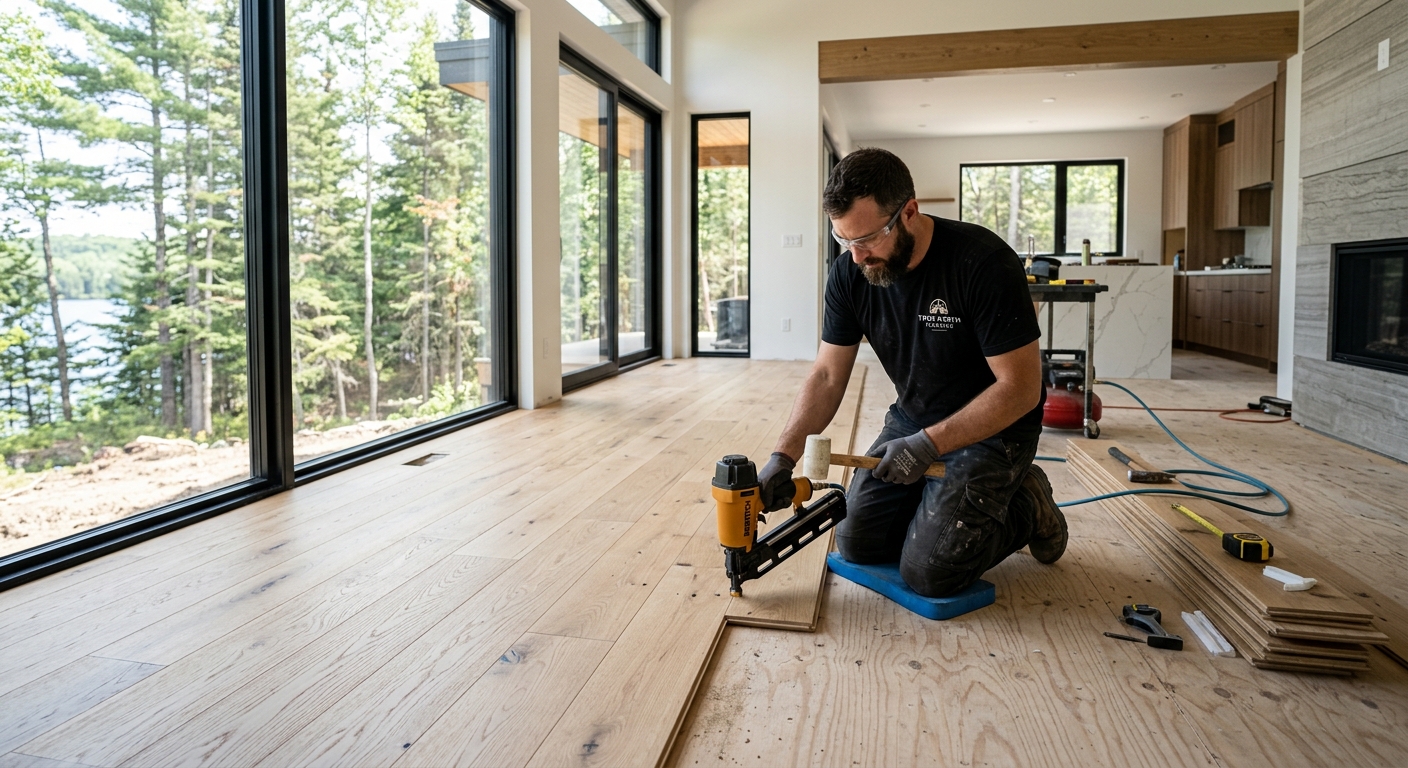
Flooring options and costs in Chatham
In Chatham, your choice of flooring usually comes down to balancing style with the realities of southwestern Ontario: dry winter air, then humid summers, plus the fact that many local basements sit over concrete that can hold moisture. With a population of 43,550 (Statistics Canada, 2021 Census), Chatham has a steady flow of renovation work, and that competition is good for pricing—when your subfloor and moisture details are clear. Where costs jump is preparation. Older homes across the Windsor–Sarnia corridor often have uneven or aging subfloors, so contractors may need patching, self-levelling compound, or even new plywood/underlay before finish flooring goes down. That prep commonly adds noticeable labour and materials premium before any hardwood, vinyl, laminate, or tile is installed.
The regional climate also shapes product performance and therefore quote pricing. Solid hardwood is sensitive to seasonal humidity swings and is not a good fit over concrete or in basements. Engineered hardwood and luxury vinyl plank (LVP) generally handle expansion/contraction and below-grade conditions better, and many LVP products are truly waterproof—meaning less risk in moisture-prone areas. If your home has radiant heat (increasing in newer construction), that can further limit options and steer budgets toward radiant-compatible engineered wood, tile, or certain vinyl systems. Trade demand is especially high in family-heavy pockets like the west end (near St. Clair Parkway and the surrounding residential streets), where kitchens and basements are commonly renovated.
Use the table below to compare typical installed ranges for common flooring types in Chatham, then you can ask for an itemised quote that matches your room size and moisture plan.
| Type |
Best Room |
Moisture Resistance |
Lifespan |
Price per sq ft |
| Solid hardwood (nail-down, above grade only) |
Main floor living areas |
Poor in basements; sensitive to humidity swings |
25–60 years (with care) |
$10–$18 |
| Engineered hardwood (float or glue, above + on-grade) |
Living/dining, bedrooms |
Good on-grade; can be used in higher-humidity rooms |
15–40 years |
$10–$18 |
| Laminate (click-lock, above-grade) |
Secondary bedrooms, offices |
Moderate; protect from standing water and damp vapour |
10–25 years |
$5–$10 |
| Luxury vinyl plank / LVP (waterproof, any level) |
Kitchens, basements, main floors |
Very good to waterproof; suitable for below-grade when prepped |
15–25 years |
$7–$12 |
| Porcelain / ceramic tile |
Bathrooms, kitchens (and entries) |
Excellent when installed correctly |
25–50 years |
$12–$22 |
| Carpet (broadloom or modular tile) |
Bedrooms, stairs comfort |
Fair; must be protected from damp slabs |
8–15 years |
$4–$9 |
Prices are estimates only and vary by project scope, site access and material selection.
What affects the price of flooring in Chatham
For the same “square footage” job in Chatham and across the Windsor–Sarnia corridor, two homeowners can receive quotes that differ by 30–50%—even when they pick the same-looking finish—because the hidden work is rarely identical. In Windsor–Sarnia, indoor humidity swings in winter and humid summers can stress certain materials, and below-grade moisture in many basements drives extra moisture controls and upgraded underlayments. In addition, older housing stock frequently needs subfloor levelling or repair, which can add an extra $1–$4 per sq ft before your finish flooring goes down. That prep is where labour time, product thickness, and installer technique all start to matter.
From a technical standpoint, solid hardwood expands and contracts with humidity. That’s why you generally cannot glue or float it over concrete, and why it performs poorly in basements with vapour pressure. Engineered hardwood and LVP handle humidity and below-grade conditions far better, so they usually reduce risk-based add-ons. Colder parts of Southwestern Ontario also have more radiant heat installs over time, and that compatibility can rule out most solid hardwood and some laminate products, nudging homeowners toward engineered wood, tile, or radiant-rated vinyl.
Here are a few practical examples that commonly change the number on your quote in Chatham: (1) if your subfloor is out of plane, you may need self-levelling—often raising your budget closer to the upper end of laminate/vinyl ranges; (2) if moisture testing shows elevated vapour, you’ll need a vapour barrier and proper underlayment, which can push the project from a mid-tier $5–$10 laminate expectation toward higher-end LVP or engineered hardwood prep costs; and (3) if the job includes patching and plywood work, labour can climb enough that tile at $12–$22 becomes competitive versus a “cheaper” floating product that keeps needing warranty-proofing measures.
| Price Factor |
Why It Matters |
Cost Impact |
| Room area in sq ft |
Materials and installation time scale directly with area. |
Higher sq ft generally increases total cost; per sq ft can slightly drop on larger jobs. |
| Subfloor condition — levelling or repair needed before install |
Uneven/aged subfloors require patching, self-levelling, or plywood overlay. |
Often adds roughly $1–$4 per sq ft depending on severity. |
| Moisture / below-grade install — rules out solid hardwood |
Vapour pressure and damp concrete require moisture testing and mitigation. |
Can add vapour barrier, testing, and upgraded underlay; can shift you toward engineered or LVP. |
| Material choice — solid vs. engineered vs. LVP vs. tile |
Different systems handle humidity, seams, and wear differently. |
Solid hardwood usually costs more; LVP can be higher than laminate but reduces moisture risk. |
| Removal and disposal of existing flooring |
Tearing out old finishes, underlayments, and nails/splinters adds labour. |
Commonly increases the quote by a material-dependent amount. |
| Stair nosing / transitions — charged per step or per linear foot |
Transitions and stair components are labour-intensive and require precise matching. |
Can noticeably increase cost in homes with many stairs and doorways. |
| Radiant heat compatibility — limits material options |
Not all products tolerate in-floor heating cycling. |
May move you to tile, engineered wood, or radiant-rated vinyl (often higher-end). |
| Installation method — float vs. glue-down vs. nail-down |
Method affects labour time, subfloor prep, and moisture control. |
Nail-down and glue-down can require more prep; floating is sometimes faster but needs correct underlayment. |
Permits & regulations in Ontario
In Ontario, installing new flooring as a finish usually does not require a building permit. Where permits can come up is with associated work that changes the building systems or electrical components. For example, if your project includes electrical work tied to in-floor heating (thermostat changes, rewiring, or circuit modifications), an electrical permit may be required. If you’re doing structural changes to subfloor framing—like replacing major load-bearing portions—then permitting requirements can apply depending on the scope.
For condominiums, the bigger “rule” is often not a government permit but the building’s own policies. Corporations may restrict flooring for sound transmission on upper floors (often referencing acoustic performance such as STC/IIC), and they may require specific underlay under hard surface flooring. Before you install hardwood, tile, or other hard finishes above grade in a multi-unit building, review the condo declaration and ask for board approval in writing.
To protect yourself in Chatham, verify your contractor step-by-step: (1) confirm they have the appropriate Ontario licence for the work they’re claiming to do (many flooring contractors will carry the relevant business profile—ask them directly what licence/credentials apply to your scope); (2) ask for a clear certificate of liability insurance naming you/your property as applicable and ensure dates match your project; (3) confirm WSIB/WCB coverage for their workers—request proof and make sure it’s active; and (4) if the job includes electrical-linked work, confirm who pulls the electrical permit and that all related subcontractors are properly covered.
Best flooring for each room in your Chatham home
In Chatham, the “best” flooring is the one that fits the room’s moisture exposure, traffic level, and comfort needs—especially given the region’s humidity swings and common basement moisture over concrete. Living and dining rooms tend to be ideal for engineered hardwood or a quality click-lock laminate: both deliver warmth and a clean look without the same humidity sensitivity as solid wood. In master bedrooms, many homeowners choose carpet for comfort and sound absorption, particularly because winter air can feel dry and carpet helps underfoot warmth.
For kitchens, LVP or large-format porcelain tile are practical choices. LVP is forgiving with everyday spills and, when installed with the right underlayment system, performs well even when humidity rises in summer. Porcelain/ceramic tile is also excellent for long-term water exposure and cleaning. In finished basements, LVP is usually the clear winner: it’s fully waterproof and can handle vapour-related conditions better than solid hardwood or most laminate, provided the concrete and underlayment are installed correctly (vapour barrier where required, and seams detailed). Bathrooms should be porcelain or ceramic tile only, because water exposure and wipe-down use patterns are unforgiving.
If your home uses radiant heat (an increasingly common feature in Ontario), choose materials rated as compatible—engineered wood, tile, and certain vinyl systems. As a cost example: upgrading from a $5–$10 laminate to an LVP option can be worth it if your basement or main floor has moisture concerns—spending more upfront can reduce costly callback issues tied to vapour and cupping.
| Room |
Best Material |
Why |
Moisture Risk |
Price Band per sq ft |
| Living / dining room |
Engineered hardwood |
Warm look with better humidity tolerance than solid wood. |
Low to moderate (manage seasonal swings, keep away from wet entry points). |
$10–$18 |
| Master bedroom |
Carpet or engineered hardwood |
Carpet adds comfort and sound control; engineered wood stays stable. |
Low (unless there are basement-adjacent moisture issues). |
$4–$18 |
| Secondary bedrooms |
Laminate |
Good value and durable surface for daily family traffic. |
Low (avoid flooding; keep humidity stable). |
$5–$10 |
| Kitchen |
Luxury vinyl plank (LVP) or porcelain tile |
Easy cleanup and strong performance with spills. |
Moderate (spill management matters; use correct transitions). |
$7–$22 |
| Basement (finished) |
LVP (waterproof system) |
Handles below-grade conditions and reduces moisture-related failures. |
High (concrete vapour risk is common; moisture testing and vapour control matter). |
$7–$12 |
| Bathroom |
Porcelain / ceramic tile |
Designed for water exposure and long-term wear. |
Very high (use proper underlay, grouting, and sealing where applicable). |
$12–$22 |
How to choose a flooring contractor in Chatham
Choosing the right flooring contractor in Chatham starts with proof, not promises. Ask for their Ontario licence details for the scope they’re performing, then request a certificate of liability insurance and verify it’s active for your dates and property. Next, confirm WSIB/WCB coverage for their workers—ask to see current clearance/coverage documentation and make sure the work crew that arrives on site is covered. This matters because flooring projects often include cutting, subfloor patching, demolition, and sometimes underlayment systems that create extra dust and substrate exposure.
Get 2–3 itemised written quotes, not one lump-sum: labour line items (removal, levelling, install, transitions), and materials line items (flooring, underlayment/vapour barrier, adhesives where required, trims, and grout/sealant for tile). Read the scope carefully: what’s excluded (e.g., extra demolition, subfloor replacement beyond a set allowance), whether a permit pull is included if radiant heating electrical changes are part of the work, and whether disposal is included. Clarify timeline: ask for a start date and a realistic completion estimate in writing.
Warranty should be clear: workmanship warranty length, product/manufacturer warranty, and whether it’s transferable if you sell. Payment schedules also protect you—never pay more than about 10–15% upfront, and hold back a portion until the job is complete and you’ve confirmed clean-up and flooring performance.
- Request current liability insurance certificate and confirm coverage for flooring work on your property.
- Verify WSIB/WCB coverage with active clearance documentation for their employees/crew.
- Ensure the quote is itemised (labour, materials, underlay/vapour barrier, transitions).
- Ask who handles moisture testing and what happens if readings exceed expectations.
- Confirm disposal is included (haul-away and dumpster/fees where applicable).
- Review what’s included for subfloor prep (levelling depth, plywood allowance, patching limits).
- Get a written start date, number of working days, and lead-time expectations.
- Check warranty terms for both workmanship and product; ask if warranties are transferable.
- Confirm stair nosings and transition pieces are priced per step/linear foot (if applicable).
- Ask about acclimation time for hardwood/engineered and how they’ll store materials on site.
- Use a payment plan that keeps holdback until flooring is finished and inspected.
- Ask for photos of similar past jobs in comparable homes around Chatham.
Red flags to watch for: (1) quotes that don’t mention moisture testing or vapour control for basements; (2) vague scopes with “flooring and install” but no line items for levelling, underlayment, or transitions; (3) requests for a large deposit (beyond 10–15%) or no holdback; (4) no proof of WSIB/WCB and liability insurance; and (5) promises that solid hardwood will be “fine” in a basement without addressing concrete moisture and humidity controls.
Frequently asked questions — flooring in Chatham
How long does flooring installation take?
In Chatham, flooring timelines depend heavily on subfloor prep and moisture control, not just the finish material. A straightforward install in one main-floor room can be completed in about 1–3 days, but many projects expand once levelling, patching, or plywood overlay is needed. For basements, allow extra time for moisture testing, vapour barrier installation, and underlayment detailing—especially over damp concrete. Tile usually takes longer than LVP or laminate because of layout planning, thinset setting time, grout work, and cure periods. If you’re installing over radiant heat, your contractor should follow manufacturer temperature rules, which can extend scheduling. If you’re budgeting around product costs like laminate at $5–$10 per sq ft or LVP in the typical $7–$12 band, build in 1–2 additional days where the quote includes levelling and moisture mitigation.
What flooring works with radiant heat?
Radiant heat in Ontario generally favours materials that tolerate temperature cycling without cracking or excessive seam movement. In practice for Chatham homeowners, the safest bets are porcelain/ceramic tile (best dimensional stability) and many engineered hardwood products that are specifically rated for in-floor heating. Certain LVP systems can also be compatible, but you must use the manufacturer’s installation instructions and any required underlayment. Solid hardwood is often limited because humidity and temperature changes can increase the risk of gapping or cupping, and many solid systems are not recommended for in-floor heating setups. Laminate can sometimes work if it’s rated for radiant heat and installed with the correct underlayment, but it depends on the product. Before you buy, ask your flooring contractor to confirm the exact model is rated for radiant heat and to provide written instructions for acclimation and commissioning so you don’t void warranties.
Engineered vs solid hardwood — what's the difference?
Solid hardwood is one continuous piece of wood (typically installed nail-down above grade). Engineered hardwood is built in layers—usually a real wood veneer on top with stable layers underneath—so it resists expansion and contraction better. In Chatham’s humidity swings, that difference matters: solid wood can be sensitive to seasonal changes and is generally not the right choice for basements or directly over concrete. Engineered hardwood can be installed on-grade and, in many moisture-managed scenarios, performs far more reliably than solid. That stability usually makes engineered a better fit if you want a hardwood look without the same risk of gaps. Pricing is often comparable on paper to regional hardwood ranges, commonly around $10–$18 per sq ft installed depending on product quality and whether your subfloor needs prep. Your contractor should still address moisture and subfloor flatness regardless of which one you choose.
Do I need to level my subfloor first?
Most flooring failures trace back to subfloor issues, so levelling is commonly needed in Chatham homes—especially in older neighbourhoods where the subfloor may be uneven, patched, or aged. If your subfloor is out of plane, floating floors can “feel springy,” click joints can stress, and tile can crack if the base isn’t properly prepared. Even for LVP, flatness matters for locked seams and long-term performance. Contractors typically check flatness with a straightedge; if it doesn’t meet the flooring manufacturer’s requirement, levelling/patching is required before installation. The cost can vary, but levelling and repair work often adds roughly $1–$4 per sq ft depending on how extensive it is. This is why quotes for “the same room size” can vary a lot across the Windsor–Sarnia corridor—one job may include straightforward install, while another includes levelling, plywood repair, and moisture controls first.
What's the most durable flooring for pets and kids?
For homes with pets and kids in Chatham, durability usually means scratch resistance, easy cleaning, and practical water handling. Luxury vinyl plank (LVP) is often the top choice because many products are waterproof and resilient against everyday spills and messes—particularly helpful in kitchens and finished basements. A quality installation with the right underlayment and seam detailing reduces the risk of moisture-related problems, which matters in below-grade conditions over concrete. If you prefer a more “natural” look, engineered hardwood can work well above grade, but it’s less forgiving than waterproof vinyl if accidents involve standing water. Tile is also very durable for high-traffic zones and wet messes, but it can be harder and colder to walk on. If you’re comparing budgets, laminate is frequently the lower-cost durable option at $5–$10 per sq ft, but it’s generally less tolerant of moisture than LVP. For maximum everyday resilience, LVP is usually the most forgiving selection.
How do I choose flooring for humidity in Chatham?
Humidity is the big deciding factor in Chatham because winter dryness and summer humidity swings can affect how materials expand and contract, and because many basements involve vapour pressure over concrete. Start by identifying the moisture risk of the space: basements and areas over slabs typically require moisture testing and vapour control before installation. In those zones, solid hardwood is usually a poor choice. Engineered hardwood and LVP generally tolerate humidity changes better, and many LVP systems are waterproof—making them a safer bet if you’ve had dampness concerns. Colder Ontario conditions and sometimes radiant heat also influence selection; if you have in-floor heating, choose radiant-compatible products to avoid warranty issues. If your contractor includes moisture testing and the correct underlayment/vapour barrier plan, your results are more predictable. Budget-wise, you may spend more than entry-level laminate ($5–$10 per sq ft), but upgraded prep and a more humidity-tolerant product can prevent expensive callbacks and replacement.