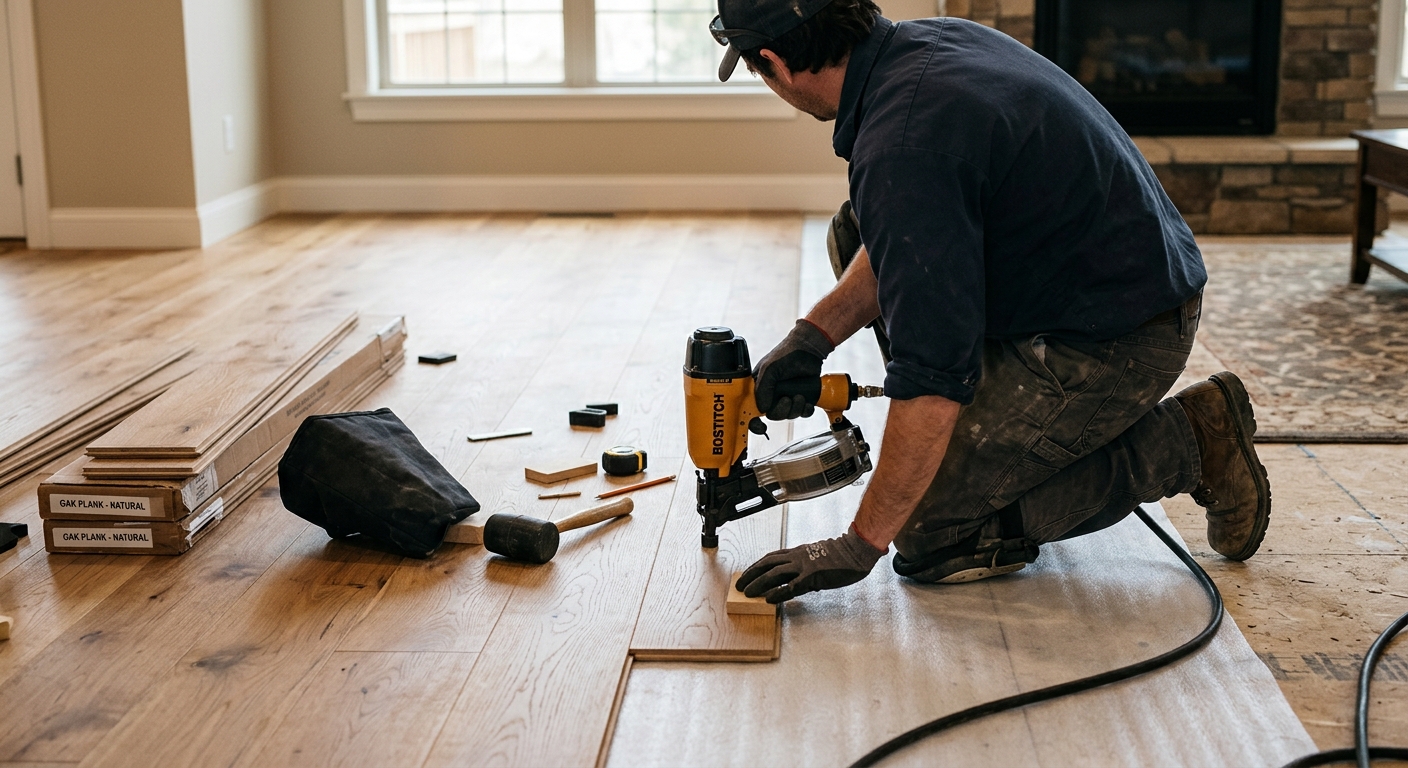
Flooring options and costs in Heritage Pointe
Flooring in Heritage Pointe is where product choice and climate timing meet real-world trade pricing. With a population of 2,075 (Statistics Canada, 2021 Census), the local builder and renovation pipeline is small enough that installers often have to schedule efficiently, but the bigger cost swings still come from how Calgary’s dry, cold prairie climate moves moisture through homes. Many Heritage Pointe properties reflect older neighbourhood builds typical of the broader Calgary region, and when floors aren’t perfectly flat, you can see subfloor levelling or repair before new materials go down—commonly adding roughly 1 to 3 per sq ft depending on how out-of-level the concrete or plywood is.
Calgary also has large seasonal humidity swings, so quotes vary: solid hardwood expands and contracts with indoor humidity and isn’t a good fit over concrete or for below-grade basements. In contrast, engineered hardwood and luxury vinyl plank (LVP) are far more dimensionally stable, which is why many homeowners budget for them when they want consistency from winter to summer. If you’re renovating around Heritage Pointe’s busier residential clusters—like the areas near local parks and school corridors—flooring labour demand tends to be higher, especially when trim reinstallation and stair work are part of the scope.
Below is a practical comparison of typical material expectations and what they usually cost per sq ft so you can line up your contractor discussions, then confirm the final numbers with an itemised quote.
| Type |
Best Room |
Moisture Resistance |
Lifespan |
Price per sq ft |
| Solid hardwood (nail-down, above grade only) |
Living / dining |
Low (humidity-sensitive) |
25–60 years |
$8–$15 |
| Engineered hardwood (float or glue, above + on-grade) |
Living / bedrooms |
Medium to high (more stable) |
20–40 years |
$8–$13 |
| Laminate (click-lock, above-grade) |
Bedrooms / offices |
Medium (needs dry subfloor) |
10–25 years |
$3–$7 |
| Luxury vinyl plank / LVP (waterproof, any level) |
Kitchen / basements |
High to waterproof |
15–25 years |
$4–$9 |
| Porcelain / ceramic tile |
Bathrooms / wet areas |
High (surface impervious) |
25–50 years |
$6–$12 |
| Carpet (broadloom or modular tile) |
Bedrooms |
Low to medium (keep dry) |
8–20 years |
$5–$9 |
Prices are estimates only and vary by project scope, site access and material selection.
What affects the price of flooring in Heritage Pointe
Two homeowners in Calgary can receive quotes that differ by 30% to 50% for what looks like “the same floor,” and it usually comes down to the hidden work: subfloor prep, moisture considerations, and how detailed the install and trim transitions need to be. In Heritage Pointe and the surrounding Calgary market, indoor humidity swings and below-grade moisture migration are key technical drivers. Solid hardwood expands and contracts with humidity; it also isn’t meant to be glued or floated over concrete. That means a baseline “hardwood quote” often turns into an engineered hardwood or LVP job once the installer factors in slab conditions, radiant heat compatibility, and basement performance.
Radiant heat is another pricing lever in Alberta. Many newer builds and renovated homes include in-floor heating, and that can rule out most solid hardwood and some laminate—so labour and materials are adjusted accordingly. On top of that, older regional housing stock frequently needs levelling or repair: plan for prep that can add around $1 to $4 per sq ft when you’re correcting waves, high spots, or damaged plywood seams.
Concrete examples from Heritage Pointe projects: if your basement slab shows moisture-related issues, contractors often steer you to waterproof LVP or SPC, which can raise material cost versus basic laminate (often $3 to $7 per sq ft), but reduces risk versus a solid wood investment. If you choose tile, the flatness tolerance is stricter—so extra self-levelling and crack isolation can push total labour higher even when tile itself is within the $6 to $12 per sq ft band.
| Price Factor |
Why It Matters |
Cost Impact |
| Room area in sq ft |
More square footage increases material quantity and install labour hours |
Directly proportional; bigger jobs can lower per-sq-ft cost |
| Subfloor condition |
Levelling or repair is required for flatness and adhesion |
Often adds $1 to $4 per sq ft in older homes |
| Moisture / below-grade install |
Concrete and vapour drive can damage solid wood and many laminate setups |
Can switch you to LVP/SPC and add moisture-safe underlay details |
| Material choice |
Solid vs. engineered vs. LVP vs. tile changes both stability and labour difficulty |
Typical bands: LVP/SPC $4–$9; tile $6–$12; solid hardwood $8–$15 |
| Removal and disposal of existing flooring |
Existing layers add time for tear-out, haul-away and prep cleanup |
Commonly adds a noticeable labour premium, especially with thick underlay |
| Stair nosing / transitions |
Stairs require custom finishing and additional pieces per step |
Often charged per step or per linear foot; can increase total budget |
| Radiant heat compatibility |
Not all products are approved for heat exposure or warranty conditions |
May require engineered/LVP; can add testing/underlay specifications |
| Installation method |
Floating, glue-down, or nail-down changes labour complexity and prep demands |
Glue-down and tile work generally cost more per sq ft than simple floating |
Permits & regulations in Alberta
In Alberta, installing new flooring itself typically does not require a building permit. That means a normal hardwood nail-down, engineered click system, LVP floating install, or carpet replacement is usually a “no permit” scope. However, certain associated work can trigger permitting. For example, if you’re doing subfloor structural repairs that go beyond cosmetic patching, remediating significant moisture with membrane systems tied to building envelope issues, or altering in-floor heating systems and electrical circuits, you may need electrical permits or inspections depending on how the work is defined.
In condominiums in and around Heritage Pointe, the bigger restriction is often the building’s rules, not a government permit. Sound transmission requirements (commonly discussed through STC/IIC performance expectations) can restrict hard flooring on upper floors. Many condo boards require specific underlay and proper installation so impact sounds stay within the building’s criteria. Before any work starts, request board approval in writing—especially for hardwood or tile.
Step-by-step verification for a Heritage Pointe homeowner:
- Confirm the contractor’s Alberta licence and business details via provincial online registries (use the exact legal name on the quote).
- Request a current certificate of liability insurance and confirm the coverage amount matches the scope.
- Verify WSIB/WCB coverage (and obtain the clearance letter if they provide it) before signing.
- Ask for the product warranty information and who covers workmanship vs materials.
Best flooring for each room in your Heritage Pointe home
In Heritage Pointe, the best flooring choices are the ones that “behave” through winter dry air and summer humidity—while also respecting moisture exposure. For living and dining rooms, engineered hardwood is a strong balance: it delivers the look you want with better dimensional stability than solid ¾-inch hardwood. If you want a lower-cost alternative, high-quality laminate can work on above-grade floors, but it still needs a dry, well-prepped substrate. For master bedrooms, carpet remains popular because it improves comfort and reduces sound transmission, and it’s forgiving during the seasonal dryness Alberta homeowners feel.
In kitchens, choose luxury vinyl plank (LVP) or large-format porcelain tile. LVP handles splashes and routine cleaning well, and it also tolerates the typical humidity swings better than solid wood. In basements (finished), LVP or SPC is usually the clear winner: waterproof construction and stable cores reduce the risk that vapour migration and slab temperature changes create—something solid hardwood and most laminate are not designed to handle.
Bathrooms should be porcelain or ceramic tile only for the best long-term performance. And if you have radiant heat (or plan to add it), prioritise radiant-compatible products; solid hardwood and some laminate systems can be excluded by manufacturer warranty or require strict installation parameters.
To see where pricing makes sense: upgrading from a $3–$7 laminate band to an engineered hardwood band ($8–$15 for solid, typically similar for mid-range engineered depending on brand/finish) can cost more upfront, but it often pays back in appearance retention, easier refinishing expectations (where applicable), and better stability across Calgary’s seasonal swings.
| Room |
Best Material |
Why |
Moisture Risk |
Price Band per sq ft |
| Living / dining room |
Engineered hardwood |
Warm look with better stability through humidity swings |
Low (above-grade, controlled interior conditions) |
$8–$13 |
| Master bedroom |
Carpet or engineered hardwood |
Comfort and sound control with optional stability-focused hardwood |
Low (keep ventilation steady) |
$5–$9 (carpet); $8–$13 (engineered) |
| Secondary bedrooms |
High-quality laminate or carpet |
Budget-friendly durability in a lower-moisture footprint |
Low to medium (avoid spills and prolonged wet mopping) |
$3–$7 (laminate); $5–$9 (carpet) |
| Kitchen |
Luxury vinyl plank (LVP) or porcelain tile |
Easy cleanup and strong resistance to everyday water exposure |
Medium (spills and steam cycles) |
$4–$9 (LVP); $6–$12 (tile) |
| Basement (finished) |
LVP / waterproof SPC |
Handles vapour and temperature swings; reduces call-backs from moisture |
High (slab moisture migration risk) |
$4–$9 |
| Bathroom |
Porcelain / ceramic tile |
Impervious surface designed for wet-area performance |
High (direct wet use) |
$6–$12 |
How to choose a contractor in Heritage Pointe
Choosing the right contractor in Heritage Pointe is mostly about verification and clarity. In Alberta, flooring work usually doesn’t require permits, but reputable installers still need the right coverage to protect you. First, confirm their Alberta licence (where applicable to their business structure and trade scope). Next, request a certificate of liability insurance and make sure the dates cover your project. Finally, verify WSIB/WCB clearance—ask for a clearance letter rather than “we’re covered,” and confirm it matches the company name on the contract.
Then get 2 to 3 itemised written quotes. Look for a breakdown that separates labour, subfloor prep/levelling materials, underlay or membrane selections, stair work, and disposal. A lump-sum number is hard to compare. Read the scope carefully: what’s included (moving furniture, tear-out, disposal/haul-away, transition trims, stair nosing) and what’s excluded (subfloor moisture remediation, extra levelling beyond a certain depth, floor-to-ceiling flush adjustments, or damage repair). Ask whether disposal is included and whether they will protect cabinetry and walls.
Warranty matters: confirm workmanship warranty length in writing and whether it’s transferable to future owners. Also confirm the product/manufacturer warranty terms—especially for basements and radiant heat installations. Payment should stay conservative: never pay more than 10% to 15% upfront. Hold back a portion until the job is complete and you’ve reviewed punch-list items.
Get a written start date and an estimated completion timeline, and ask how they handle delays for material lead times—especially during peak flooring seasons in the Calgary region.
- Use the legal company name on the quote and verify it matches their insurance documents.
- Ask for WSIB/WCB clearance letter before signing.
- Confirm liability insurance limits and whether the policy includes your project address.
- Require an itemised quote: labour, materials, underlay/membranes, and subfloor prep.
- Clarify removal and disposal: included or extra?
- Confirm stair work pricing: per step or per linear foot for transitions.
- Ask how they check flatness and what tolerance they aim for (especially for tile).
- Confirm underlay/membrane selection for LVP/SPC or laminate (and why).
- Verify radiant heat compatibility for any hard surface you’re considering.
- Get warranty in writing: workmanship and product coverage details.
- Never allow a full upfront payment; use milestone payments tied to completed stages.
- Ensure the contract includes a punch-list and a final walk-through date.
Red flags to watch for in Heritage Pointe: quotes that don’t mention subfloor levelling despite known older flooring transitions; no written scope for disposal or stair nosing; refusal to provide WSIB/WCB clearance or liability certificate; “we’ll figure it out later” language around moisture conditions in basements; and warranties that are verbal only or unusually short compared to typical workmanship coverage.
Frequently asked questions — flooring in Heritage Pointe
Hardwood vs laminate vs vinyl plank — which is best?
In Heritage Pointe and the broader Calgary climate, “best” depends on moisture exposure and your tolerance for seasonal movement. Solid hardwood is beautiful above grade, but it’s humidity-sensitive and not a basement-friendly choice. Laminate is usually the most cost-efficient option in the $3–$7 per sq ft band, but it still needs a dry, well-prepped substrate and isn’t ideal for below-grade vapour conditions. Luxury vinyl plank (LVP) or waterproof SPC is the practical winner when your main concern is stability across large humidity swings—especially if there’s any basement risk. If you’re choosing for a living area above grade, engineered hardwood is often the compromise between warmth and stability; if you’re choosing for kitchens or basements, LVP/SPC typically reduces call-backs and makes your warranty posture stronger.
What flooring is best for a Heritage Pointe basement?
For most Heritage Pointe basements, waterproof LVP or SPC is the best starting point because below-grade slabs can drive moisture vapour into the space even when the room feels dry. That’s exactly where solid hardwood and many laminate systems can struggle: humidity movement and slab temperature changes can lead to cupping, gapping, or joint separation over time. LVP/SPC is dimensionally stable and designed to handle moisture exposure better, and many installations can be done on typical below-grade subfloor conditions with the right underlayment approach. If you have known moisture issues, ask contractors to explain their moisture-check process and what prep they’ll do before installation. In Alberta, selecting the correct basement flooring can be more important than chasing the lowest per-sq-ft number.
Can I install hardwood over concrete?
Usually, you can’t install traditional solid nail-down hardwood over concrete, and you should avoid floating or gluing solid hardwood directly to slab without the correct system approvals. The core issue is that solid wood is humidity-sensitive, and concrete can transmit moisture vapour that can damage the flooring and cause movement. If you’re set on a wood look over concrete, engineered hardwood is typically the safer option because it’s more stable through humidity swings. Always follow the manufacturer’s installation instructions for slab conditions, including moisture testing requirements and any required membranes. In an Alberta setting like Heritage Pointe, the safer pathway is often to test and then choose engineered wood or switch to LVP/SPC if basements are part of the scope.
How long does flooring installation take?
Timelines depend on square footage, subfloor prep, and how many transitions or stairs are involved. A straightforward above-grade LVP or laminate install with good flatness can move quickly, often within a few days for typical Heritage Pointe homes. Tile and projects with significant levelling usually take longer because prep and curing time matter. Expect extra time if removal and disposal are included, if there are stair nosings to fabricate, or if your concrete or plywood is out of level and requires more self-levelling. Ask your contractor for a start date and an estimated completion window in writing, and confirm whether materials delivery could extend the schedule. A clear plan for subfloor prep is what keeps your job from stretching.
What flooring works with radiant heat?
Radiant heat compatibility is product-specific, but in Alberta the common rule is: avoid solid hardwood unless the manufacturer explicitly approves it for radiant systems and you can meet their requirements. Many solid wood warranties become difficult with in-floor heating because of the predictable temperature changes and indoor humidity movement. Engineered hardwood is more often approved than solid for many radiant applications, and LVP/SPC is also commonly used because it’s stable through temperature cycling when installed correctly. Laminate may be approved for some radiant systems, but you need the specific manufacturer rating and a compatible underlayment. Before you commit, ask your contractor to reference the exact product installation instructions for radiant heat and confirm the plan for acclimation and any subfloor requirements.
Engineered vs solid hardwood — what's the difference?
Solid hardwood is one continuous piece of wood, typically installed nail-down on above-grade subfloors. Its performance depends heavily on indoor humidity consistency, which is why it’s often limited to main floors and not recommended for most basements in Heritage Pointe. Engineered hardwood uses a plywood or composite core with a hardwood wear layer on top. Because of that layered construction, it handles seasonal humidity swings and temperature changes more predictably, making it a better choice when you want a wood look over on-grade areas or in environments where concrete and humidity variations are a concern. Both can look excellent, but the safer selection in Alberta’s dry-cold climate—especially when moisture migration is a factor—is usually engineered. Cost-wise, solid hardwood often sits in the $8–$15 per sq ft band, while engineered commonly lands in a similar mid-range depending on the product line.