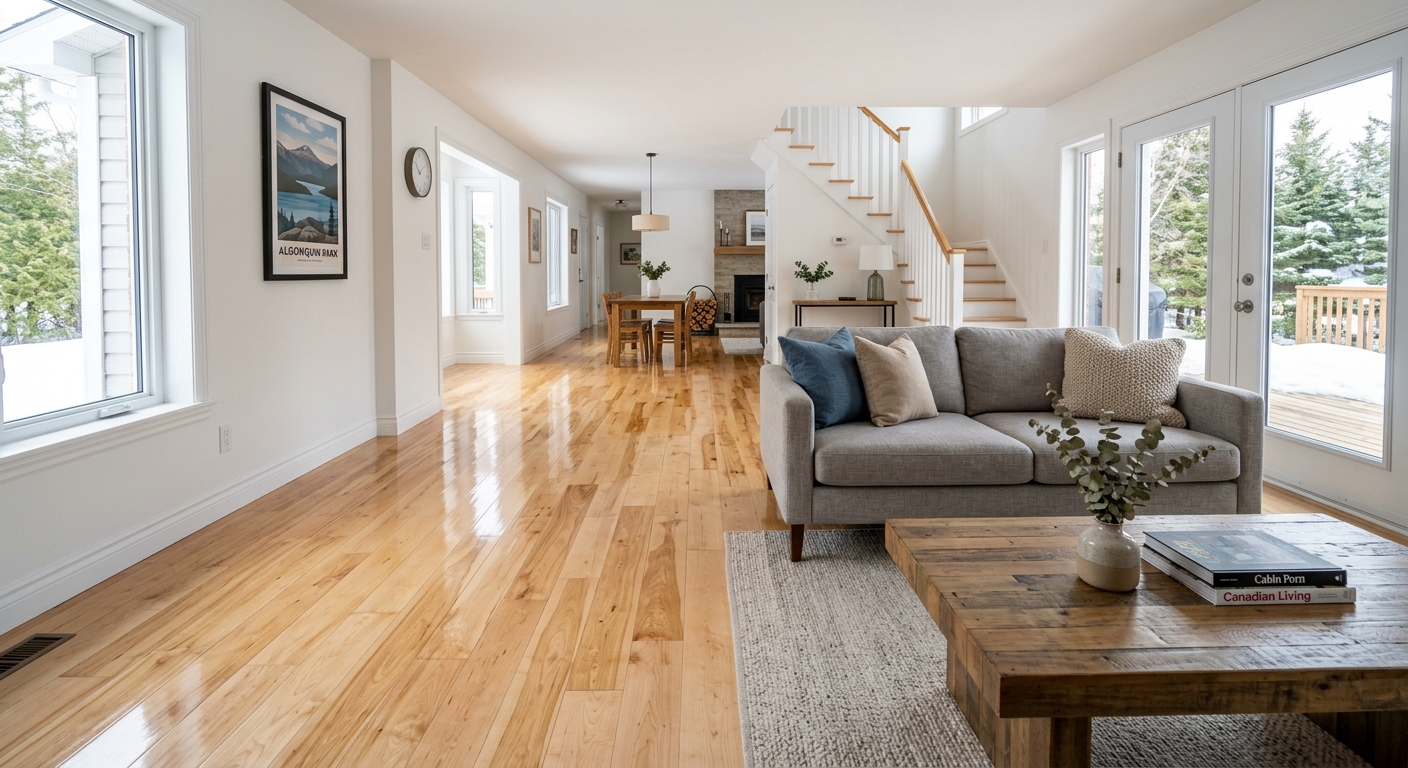
Flooring options and costs in Glenwood
In Glenwood, the right flooring choice is mostly about matching materials to our wet, marine Lower Mainland–Southwest climate. Even when you’re on the main level, indoor humidity swings—especially in winter and shoulder seasons—can lead to seasonal gapping or cupping in improperly installed wood. That matters because Glenwood is also shaped by older housing stock: in communities across the Lower Mainland–Southwest, a large portion of homes are in the pre-renovation category, and when subfloors are uneven or moisture is moving through slabs, you can easily add levelling and prep work (often around $1–$3 per sq ft, depending on how bad it is). With a population of 11,437 (Statistics Canada, 2021 Census), there’s consistent demand for renovation labour, particularly where homes are updated room-by-room rather than all at once.
Contractor availability and total project cost also reflect how the region builds and retrofits. Basements and slab-on-grade areas in nearby urban centres frequently see moisture wicking through concrete, so installers in Glenwood generally avoid solid hardwood below grade and recommend engineered wood or luxury vinyl plank (LVP) instead. If your home is in a high-turnover renovation pocket—many homeowners focus on the older, character-heavy areas closer to downtown-style commercial strips and established residential blocks—there’s typically more competition for scheduling, but you still pay a premium for proper moisture testing and subfloor correction.
Below is a realistic cost comparison for Glenwood, assuming typical site access and standard room prep, so you can budget before the detailed quote visit.
| Type |
Best Room |
Moisture Resistance |
Lifespan |
Price per sq ft |
| Solid hardwood (nail-down, above grade only) |
Main living areas |
Low to moderate (humidity sensitive; not recommended below grade) |
25–60 years |
$9 – $18 |
| Engineered hardwood (float or glue, above + on-grade) |
Living rooms, bedrooms (on grade) |
Moderate to high (layered construction tolerates swings better) |
20–35 years |
$8 – $16 |
| Laminate (click-lock, above-grade) |
Bedrooms, hallways, living spaces |
Moderate (water-resistant top; edges can swell if flooded) |
10–25 years |
$4 – $10 |
| Luxury vinyl plank / LVP (waterproof, any level) |
Kitchen, basements, rec rooms |
High (PVC core and sealed surface handle vapour and spills) |
15–25 years |
$5 – $12 |
| Porcelain / ceramic tile |
Bathrooms, kitchens, entries |
Very high (with correct underlayment and sealing) |
25–50 years |
$10 – $20 |
| Carpet (broadloom or modular tile) |
Bedrooms, stairs, comfort zones |
Low (absorbs moisture; needs good ventilation) |
7–15 years |
$6 – $12 |
Prices are estimates only and vary by project scope, site access and material selection.
What affects the price of flooring in Glenwood
In Glenwood and the broader Lower Mainland–Southwest, it’s common to see quotes for the same square footage land 30% to 50% apart. The difference usually isn’t the “flooring type” alone—it’s the hidden prep, subfloor correction, and the way a contractor handles moisture and transitions. In a region where indoor humidity swings are noticeable and where basements and slab-on-grade areas can experience moisture wicking, the labour component can rise quickly. That’s why two homeowners can both choose engineered hardwood, but one ends up paying more because their plywood needs levelling or a moisture mitigation layer before install.
Technically, the biggest driver is moisture behaviour. Solid hardwood expands and contracts with humidity, so it can’t be glued or floated over concrete and performs poorly in basements. Engineered hardwood and LVP handle humidity and below-grade applications far better because their layered or PVC cores tolerate minor temperature and moisture variation. Colder inland pockets and many newer Lower Mainland–Southwest builds also use radiant heating; that can further limit solid hardwood and some lower-grade laminate options, steering you toward engineered wood, tile, or higher-rated laminate.
Older housing stock is another consistent cost add. When subfloors need levelling or repair, you can add roughly $1–$4 per sq ft before a single plank goes down. For example, one Glenwood homeowner might budget laminate at $4–$10 per sq ft and then discover $2 per sq ft in prep because the existing underlayment is uneven. Conversely, a basement can look “expensive” on paper until you compare: LVP at $5–$12 per sq ft often avoids moisture-related failures and rework that would be much costlier with solid wood.
| Price Factor |
Why It Matters |
Cost Impact |
| Room area in sq ft |
Material quantity and labour time scale directly with square footage |
Higher area increases total cost; per-sq-ft can drop slightly on larger jobs |
| Subfloor condition — levelling or repair needed before install |
Uneven plywood/concrete must be corrected for a flat finish and to prevent squeaks |
Commonly adds about $1–$4 per sq ft depending on severity |
| Moisture / below-grade install — rules out solid hardwood |
Basements and slab areas may need moisture barriers and sealed systems |
Can add prep materials and increase labour; changes recommended product type |
| Material choice — solid vs. engineered vs. LVP vs. tile |
Different products have different install methods and material costs |
Shifts you between typical bands like $4–$10 (laminate/LVP) and $10–$20 (tile) |
| Removal and disposal of existing flooring |
Demolition adds labour; disposal fees vary with volume |
Often a significant line item on older homes with multiple layers |
| Stair nosing / transitions — charged per step or per linear foot |
Transitions require trimming, edging pieces, and careful height matching |
Can add several hundred dollars on homes with stairs and multiple room breakpoints |
| Radiant heat compatibility — limits material options |
Not every product tolerates heat cycling |
May require engineered wood, LVP-rated products, or tile (higher material costs) |
| Installation method — float vs. glue-down vs. nail-down |
Different methods require different subfloor preparation and trade labour |
Glue-down typically costs more than click-lock; nail-down can be cheaper than glue if subfloor is perfect |
Permits & regulations in British Columbia
In British Columbia, the act of installing new flooring typically does not require a building permit by itself. However, there are common “associated work” items that can trigger permits, especially if you’re touching systems rather than just surfaces. For example, if you’re doing subfloor structural repair (like replacing damaged structural members), moisture remediation that requires specific remediation steps, or installing or modifying in-floor heating circuits, you may need appropriate permits. If your scope involves electrical work tied to radiant heating controls, that can require an electrical permit through the proper channels.
For condominiums in Glenwood and across B.C., permissions often come from the building itself rather than a city permit. Many corporations restrict or require specific underlay and sound-control strategies for hardwood and tile to meet sound transmission expectations (commonly discussed as STC/IIC performance). Before installing hard flooring on an upper floor, review your condo declaration and request board approval in writing—especially for hardwood, engineered wood, and tile installations.
To verify your contractor in British Columbia, start by confirming their business registration and checking whether they hold any applicable provincial licensing for related scopes (such as any electrical or structural work they might subcontract). Ask for their liability insurance certificate and look for clear project coverage. If the contractor has employees, request proof of WSIB/WCB coverage. Finally, keep a copy of the clearance letter or equivalent documentation they provide. For additional assurance, request their written workmanship warranty and keep your quote, scope, and schedule in the same folder.
Best flooring for each room in your Glenwood home
Choosing the best flooring in Glenwood comes down to traffic, comfort, and—because we’re in the Lower Mainland–Southwest—how each room deals with moisture and seasonal indoor humidity swings. For living and dining areas, engineered hardwood or high-quality laminate is usually the sweet spot: you get a warm, natural look with better tolerance than solid hardwood when humidity shifts. For bedrooms, carpet is still a favourite in many Glenwood homes because it reduces noise and feels warmer underfoot, but it’s best when ventilation and humidity control are good. Master bedrooms often suit carpet or engineered wood depending on allergies and pets.
In kitchens, use products that handle everyday spills. Luxury vinyl plank (LVP) is popular because it’s waterproof and forgiving when someone tracks in damp weather, which happens often in a marine climate. Tile is also excellent, especially large-format porcelain; it’s durable and easy to clean, and it can handle seasonal moisture exposure when installed correctly. Basements (finished) are the clearest case: LVP typically wins because it’s fully waterproof and can handle moisture vapour and below-grade installations that solid wood and most laminate cannot. Bathrooms should be porcelain or ceramic tile only.
If you have radiant heating, material compatibility matters. Engineered wood and LVP are often easier to spec to radiant systems than solid hardwood, which needs careful installation conditions. As a cost example: if you’re choosing between laminate at $4–$10 per sq ft and LVP at $5–$12 per sq ft for a finished basement, the extra $1–$2 per sq ft is usually justified because it reduces the risk of edge swelling and moisture-driven callbacks in a wet, humidity-prone environment.
| Room |
Best Material |
Why |
Moisture Risk |
Price Band per sq ft |
| Living / dining room |
Engineered hardwood |
Warm look with better humidity tolerance than solid; works well for typical above-grade humidity swings |
Low to moderate |
$8 – $16 |
| Master bedroom |
Carpet or engineered hardwood |
Comfort and sound control with carpet; stability and easier maintenance with engineered |
Low |
$6 – $12 |
| Secondary bedrooms |
Laminate (better-rated) or LVP in play areas |
Laminate is cost-effective for dry rooms; LVP is a safer choice if kids bring in damp footwear |
Low to moderate |
$4 – $10 |
| Kitchen |
Luxury vinyl plank (LVP) or porcelain tile |
Handles spills and frequent cleaning; LVP is quieter, tile is highly scratch-resistant |
Moderate |
$5 – $20 |
| Basement (finished) |
Luxury vinyl plank (LVP) |
Waterproof surface for vapour exposure; avoids the risk profile of solid hardwood below grade |
High (seasonal moisture and vapour) |
$5 – $12 |
| Bathroom |
Porcelain / ceramic tile |
Best long-term wet-area performance when paired with proper underlayment and sealing |
Very high |
$10 – $20 |
How to choose a flooring contractor in Glenwood
When you’re hiring a flooring contractor in Glenwood, you want three things verified before you sign: appropriate coverage, a detailed written scope, and an installation approach that matches B.C.’s humidity and moisture realities. Start with liability insurance: ask for a current certificate of insurance naming you as a certificate holder when possible. If the contractor has employees, request proof of WSIB/WCB coverage and, when offered, a clearance letter. This protects you if someone is injured during demo, levelling, or subfloor prep.
Next, get 2–3 itemised written quotes. Make sure the breakdown includes separate line items for labour, subfloor levelling/repair, underlay/moisture barrier materials, transitions (especially stair nosing), and removal/disposal. Avoid “lump sum” quotes that don’t state what’s excluded—things like moving appliances, core cuts, or patching damaged plywood. For permits, confirm whether the contractor will handle any required permits for associated work (like radiant heating electrical components) and whether disposal is included.
Warranty matters in this region because moisture management is the difference between a floor that lasts and one that fails early. Ask for the workmanship warranty length, whether the product warranty is tied to the installer, and if it’s transferable if you sell your home. Payment schedule should be conservative: never more than 10–15% upfront. Hold back until the job is complete and you’ve confirmed transitions, transitions height-matching, and clean-up.
Finally, lock in timing. Get a written start date and an estimated completion window, and ask what happens if humidity conditions require material acclimation or if the subfloor needs additional correction.
- Confirm liability insurance coverage and request a certificate before work starts
- Ask for WSIB/WCB proof (and a clearance letter if they provide one)
- Get 2–3 itemised quotes with labour and materials separated
- Ensure the quote states exactly what removal includes (underlay, staples, and waste haul-away)
- Verify moisture testing or at least a moisture-behaviour assessment for basements and slab areas
- Confirm levelling/repair scope (what products, how flat is “flat,” and how unevenness is handled)
- Ask what underlayment or moisture barrier is included for your specific flooring type
- Clarify stair nosing and transition pricing per step or per linear foot
- Confirm how they handle radiant heating clearances and compatible products
- Read the exclusions list for subfloor damage, asbestos, mould, or hidden layers
- Check warranty terms: workmanship length, product warranty responsibilities, and transferability
- Use a conservative payment schedule (10–15% upfront; remainder at completion)
In Glenwood, red flags I commonly see include contractors who (1) won’t discuss moisture barriers or baseline subfloor flatness, (2) quote “solid hardwood in the basement” without a moisture plan, (3) refuse to put transition and stair pricing in writing, (4) ask for large upfront payments, and (5) can’t provide insurance or WSIB/WCB documentation on request.
Frequently asked questions — flooring in Glenwood
What is the best flooring for a high-traffic area in Glenwood?
For high-traffic areas in Glenwood, the best all-around choices are typically LVP (waterproof) or engineered hardwood with a tough wear layer. LVP is a strong option in Lower Mainland–Southwest homes because it tolerates daily moisture tracking and humidity swings better than solid wood, which is sensitive to seasonal expansion and contraction. If you expect heavy use from pets or kids, LVP’s sealed surface is forgiving and easier to clean. If you prefer the look of wood, engineered hardwood is a better fit than solid hardwood for many above-grade installs where humidity varies. In price terms, you might compare laminate or LVP ranges like $4 – $10 versus $5 – $12, and choose based on your basement risk and your willingness to manage humidity.
How do I prepare my subfloor before new flooring?
Subfloor prep is the part that most often determines whether a new floor performs well in B.C.’s climate. For Glenwood, start with a flatness check and address any squeaks or loose sections. If you’re installing floating floors (laminate or click-lock), the subfloor still needs to be properly level; otherwise, you get noise and joint stress. For engineered hardwood, many installers will also confirm suitability of your base and whether additional underlayment or a moisture barrier is required. For below-grade or slab-on-grade areas, contractors should use a moisture-aware approach: surface dryness assessment and correct vapour barrier selection, because moisture wicking can travel through concrete. A common regional cost add is levelling/repair—often roughly $1–$4 per sq ft depending on the condition.
Is cork or bamboo flooring a good choice in Glenwood?
Cork and bamboo can look great, but for Glenwood (and the Lower Mainland–Southwest generally), their suitability depends heavily on installation type and your moisture exposure. Cork and bamboo are more sensitive to standing water and persistent humidity than LVP, so they’re usually better for above-grade rooms with stable indoor conditions—think living areas and bedrooms, not finished basements. If your home has a damp basement or slab area, LVP is still the safer recommendation because it’s waterproof and built for humidity swings. Also, bamboo and cork performance can vary by product construction and whether it’s a floating click-lock system with an adequate underlay. In practice, homeowners who want a “natural” option often end up choosing engineered wood (for stability) rather than cork/bamboo to reduce callbacks. If you choose natural materials, plan for careful acclimation and proper vapour control.
What is the difference between floating and glued-down flooring?
Floating flooring is installed so planks click together and rest over an underlayment without being permanently bonded to the subfloor. This is common with laminate and many LVP systems, and it allows a bit of movement to handle normal seasonal expansion/contraction—especially helpful in Glenwood’s humidity swings. Glued-down flooring is bonded directly to the subfloor using adhesive, which can improve stability in certain conditions but makes subfloor moisture control critical. In Lower Mainland–Southwest homes, moisture vapour and uneven slab behaviour are common considerations, and glued systems require the right moisture barriers and a properly prepared base. Solid hardwood below grade generally isn’t recommended, but engineered wood can be installed in multiple ways (including glue-down) on suitable subfloors. If your quote has a big spread, ask whether it’s floating versus glue-down because the install method can shift labour and prep requirements.
What flooring holds up best to pets in a Glenwood home?
For pets in Glenwood, LVP is usually the toughest practical choice: it’s waterproof, resists moisture tracked in from wet weather, and can handle the everyday reality of spills and accidents better than carpet or solid hardwood. Engineered hardwood can also work well if you choose a thicker wear layer and maintain humidity in your home, but it’s still less forgiving in true below-grade conditions. Carpet can be comfortable, but it absorbs odours and moisture, which can become a problem when indoor humidity rises in winter and shoulder seasons. If you’re comparing budgets, many homeowners land in the $5 – $12 LVP range versus $9 – $18 for solid hardwood. For pets, the “best hold-up” often means fewer surprises from moisture and fewer replacement headaches—especially if your traffic routes pass through an entry that collects dampness.
How do I fix squeaky floors in my Glenwood home?
Squeaks usually come from movement between the subfloor layers or loose fasteners, not the finished flooring itself. In Glenwood (and older Lower Mainland–Southwest homes), squeaks often show up in areas where plywood or joists shifted slightly, or where there’s unevenness beneath a floating floor. The correct fix is typically to locate the movement point: homeowners can start by walking the area while listening, then marking the squeak locations. Professional solutions may include re-fastening subfloor panels to joists, shimming or levelling the base, or in some cases adding structural fastening. Only after the base is corrected should the flooring be reinstalled—otherwise the squeak can return and can break down joints. If you suspect moisture or concrete-related movement in a basement area, address that first because sealing over a wet base without correction can cause other problems.