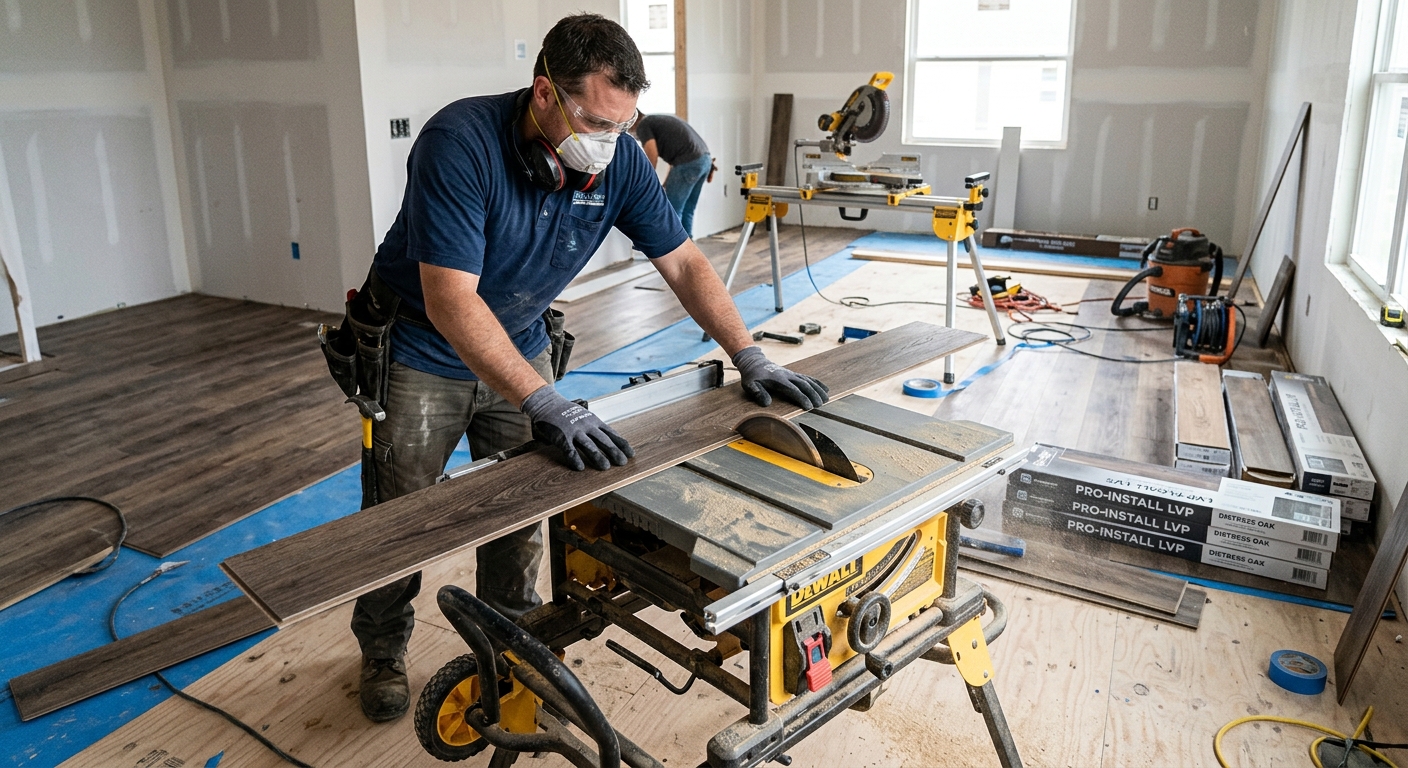
Flooring options and costs in Salmon Arm
Salmon Arm homeowners typically have a short list of favourites, but costs change quickly once you factor in the age of your home and how your subfloor behaves. In Salmon Arm, many properties were built before 1981—38.6% of dwellings in the area (Statistics Canada, 2021 Census). That older housing stock often comes with uneven framing, older OSB/plywood that needs patching, and crawlspace/basement moisture management steps before new flooring can go down. Depending on what’s under your current floor, levelling, grinding, primers, membranes, or a patch-and-skim approach can add roughly $2–$4 per square foot for wood and tile projects.
On the labour and material side, Thompson–Okanagan’s dry winters and hot, sometimes smoky summers create indoor humidity swings. That means seasonal expansion/contraction matters, and below-grade areas are where moisture management becomes a major cost driver. In parts of town with more basements and crawlspaces—like the older lakeside neighbourhoods and areas around downtown where renovation activity is common—engineered hardwood or luxury vinyl plank (LVP) is frequently recommended over solid wood. Radiant heating is also increasingly common in colder-pockets and newer builds, which steers many homeowners toward engineered wood, tile, or quality LVP that’s rated for radiant systems.
Below are realistic installed-cost bands you’ll see for common options, before site-specific extras like demolition, staircase work, or subfloor remediation. Use this as a baseline for your comparison shopping, then we’ll narrow it to your exact rooms and substrate conditions in the next section.
| Type |
Best Room |
Moisture Resistance |
Lifespan |
Price per sq ft |
| Solid hardwood (nail-down, above grade only) |
Living/dining, bedrooms (above-grade) |
Low—sensitive to humidity swings |
25–40+ years |
$12,00 – $25,00 |
| Engineered hardwood (float or glue, above + on-grade) |
Living/dining, bedrooms, main level |
Medium–High—better dimensional stability |
20–35 years |
$13,00 – $24,00 |
| Laminate (click-lock, above-grade) |
Living rooms, hallways, bedrooms |
Medium—can swell with prolonged water |
10–25 years |
$4,00 – $10,00 |
| Luxury vinyl plank / LVP (waterproof, any level) |
Kitchen, hallways, finished basements |
High—waterproof core options |
15–25 years |
$6,00 – $13,00 |
| Porcelain / ceramic tile |
Bathrooms, entries, kitchens |
High—water resistant with proper grout/seal |
25+ years |
$15,00 – $30,00 |
| Carpet (broadloom or modular tile) |
Bedrooms, stairs (comfort focus) |
Low–Medium—needs dry subfloor |
8–15 years |
$7,00 – $17,00 |
Prices are estimates only and vary by project scope, site access and material selection.
What affects the price of flooring in Salmon Arm
For the same room size, quotes in the Thompson–Okanagan and across British Columbia can land 30–50% apart because “flooring” isn’t just the finish—it’s everything needed to make it work: substrate prep, moisture mitigation, underlay, transitions, and the labour to install to local expectations. In Salmon Arm specifically, the dry winters and hot, sometimes smoky summers create humidity swings that affect wood products most. Solid hardwood expands and contracts with indoor humidity; it also can’t be glued or floated over concrete, and it performs poorly in basements. That’s why engineered hardwood and LVP are common upgrades when homeowners want a wood look without the seasonal surprises.
Cold-weather comfort also changes options. Where radiant heating is present, many installers push engineered wood, tile, or quality LVP because these are more dimensionally stable under temperature cycling. Meanwhile, Salmon Arm’s older housing stock—38.6% of homes built before 1981—often means uneven subfloors and prior renovations. Levelling, grinding, or a self-levelling underlayment step can add $1–$4 per square foot, and tile can require even tighter flatness tolerances.
Two local examples that commonly shift costs: (1) a basement floor over slab often needs an approved moisture primer and may require a membrane system before tile or engineered wood—this adds material and time. (2) if your existing floor is glued-down flooring or older carpet with heavy adhesive, removal and disposal can be a bigger line item than you’d expect, nudging your final budget upward even when you choose a mid-priced product like laminate in the $4–$10 per square foot band.
| Price Factor |
Why It Matters |
Cost Impact |
| Room area in sq ft |
Material quantities and labour hours scale directly with square footage |
Higher area usually improves efficiency but still increases total cost |
| Subfloor condition |
Levelling/repairs are required for a flat, squeak-free install |
Often adds roughly $1–$4/sq ft in older homes |
| Moisture / below-grade install |
Basements and slabs require moisture testing/primers/membranes |
Can add $2–$6/sq ft depending on system used |
| Material choice |
Solid vs engineered vs LVP vs tile have different prep tolerances and labour needs |
Shifts your baseline across bands (e.g., tile $15–$30/sq ft vs laminate/vinyl $4–$10/sq ft) |
| Removal and disposal of existing flooring |
Time-consuming demolition + disposal fees |
Often adds a noticeable percentage, especially with glued or layered materials |
| Stair nosing / transitions |
Per-step detailing and custom reducers/trim increase labour |
Commonly adds a separate line item per step or per linear foot |
| Radiant heat compatibility |
Rules out certain products and may require specific underlayment |
Can add cost through compatible products and extra testing/approvals |
| Installation method |
Float vs glue-down vs nail-down changes prep and installation labour |
Glue-down and nail-down typically cost more than click-lock in many cases |
Permits & regulations in British Columbia
In British Columbia, flooring installation itself usually does not require a building permit. Swapping out finishes—like laminate, carpet, LVP, tile, or engineered hardwood—typically falls under standard renovation work without permit requirements. The exceptions are usually tied to associated work, not the flooring surface itself.
Permit-triggering examples homeowners should watch for include: electrical work connected to in-floor heating circuits (new wiring, modifications to thermostats, or changes that require electrical inspection), major structural repairs to framing or subfloor joists (when walls or structural members are altered), and any moisture remediation that requires engineered solutions or related building envelope interventions. In condominiums, the corporation’s rules on sound transmission (often referenced through STC/IIC expectations) can also restrict what underlay you’re allowed to use under hard flooring on upper floors.
How to verify a contractor in Salmon Arm step-by-step:
- Ask for their current British Columbia licence/registration information (if applicable to their trade scope) and confirm it through the appropriate online registry.
- Request a current Certificate of Insurance (liability) and make sure it’s valid for the project dates.
- For workplace safety compliance, ask whether they carry WCB/WSBC coverage and request a clearance letter or proof that meets project requirements.
- Get condo approval in writing before the first day of work when you’re installing hardwood or tile above other units.
Best flooring for each room in your Salmon Arm home
Choosing flooring in Salmon Arm is about matching the product to moisture, traffic, and comfort—especially with Thompson–Okanagan’s humidity swings and the mix of crawlspaces and basements. In living and dining areas, engineered hardwood or high-quality laminate gives a warmer feel without the same humidity sensitivity as solid wood. For a master bedroom, many homeowners pick carpet for comfort and sound absorption, or engineered hardwood if they want an easy-clean, consistent look.
In kitchens, LVP is a go-to because it handles splashes and quick cleanups, and it stands up well to the real-world spills that happen in family homes. If you want a “forever” surface, large-format porcelain tile is excellent too, but it’s usually higher cost—often in the $15,00 – $30,00 installed band once you include proper prep. In basements (finished), LVP is typically the clear winner: it’s waterproof, manages moisture vapour better than solid wood, and tolerates the minor slab or humidity movement that can show up in below-grade areas.
For bathrooms, porcelain or ceramic tile is the safest choice, provided the subfloor is properly prepared and the installation is done with the correct waterproofing approach. If your home has radiant heating (common in newer BC builds), prioritise products that are specifically rated for radiant systems—engineered wood, tile, and many quality LVP options are usually the best-fit categories, while most solid hardwood and some laminate products are more limited.
For example, if your main level is 500 sq ft, moving from laminate (often $4,00 – $10,00/sq ft) to engineered hardwood (often in the higher range) can look pricey on paper. But if your subfloor needs only minor patching and you want a longer lifespan and better stability through seasonal humidity swings, that difference can be justified.
| Room |
Best Material |
Why |
Moisture Risk |
Price Band per sq ft |
| Living / dining room |
Engineered hardwood |
Warm look with better stability through seasonal humidity changes |
Low–Medium (manageable with proper indoor humidity) |
$13,00 – $24,00 |
| Master bedroom |
Carpet or engineered hardwood |
Carpet improves comfort and noise; engineered keeps an easy-clean option |
Low (avoid spills; use proper underlay) |
$7,00 – $17,00 |
| Secondary bedrooms |
Carpet or quality laminate |
Comfort for daily use; laminate adds durability on a budget |
Low |
$4,00 – $17,00 |
| Kitchen |
Luxury vinyl plank (LVP) or porcelain tile |
LVP handles spills; tile offers the most robust cleanability |
Medium (water and food moisture) |
$6,00 – $30,00 |
| Basement (finished) |
Luxury vinyl plank (LVP) |
Waterproof performance and better tolerance for below-grade conditions |
Medium–High (vapour and occasional leaks) |
$6,00 – $13,00 |
| Bathroom |
Porcelain / ceramic tile |
Best resistance to ongoing water exposure with correct installation |
High |
$15,00 – $30,00 |
How to choose a flooring contractor in Salmon Arm
Start by verifying credentials the right way. In British Columbia, ask your flooring contractor for their current liability insurance Certificate of Insurance and confirm the policy is active for your project dates. For workplace safety coverage, request proof of WCB/WSBC clearance (a clearance letter or equivalent proof) so you know the crew is compliant on-site. If their trade scope requires specific registration or licensing, confirm it through the appropriate BC online registry.
Next, get 2–3 itemised written quotes—not lump sums. You want labour and materials separated, including subfloor prep steps (levelling, patching, primers/membranes if needed), underlay, transitions, and stair work. Read the scope carefully: confirm what’s included for removal and disposal, whether plywood/OSB repairs are part of the base price, and whether permits or electrical coordination are included if radiant heating or electrical changes are involved.
Warranty matters twice: workmanship coverage (how long the installer stands behind the install), product/manufacturer warranty (what’s covered if the flooring is defective), and whether the warranty is transferable to you. For payment scheduling, never pay more than about 10–15% upfront, and hold back a portion until the job is complete and you’ve received final walkthrough sign-off. Also request a start date and completion estimate in writing so the timeline doesn’t drift.
- Verify BC insurance and request proof of WCB/WSBC coverage before signing.
- Ask for an itemised quote: materials, labour, subfloor prep, underlay, transitions.
- Confirm inclusion/exclusion of demolition and disposal fees.
- Ask whether moisture testing and a primer/membrane are included for basements/slabs.
- Check the flatness standard they’ll meet before tile or engineered installation.
- Confirm stair nosing details, per-step pricing, and finish transitions.
- Request product data sheets showing radiant-heat compatibility if relevant.
- Ask about acclimation time for wood/LVP and who provides the climate instructions.
- Ensure the workmanship warranty length is clearly written in the contract.
- Confirm warranty procedures for defects (who contacts the manufacturer, timelines).
- Use a clear schedule for payments (10–15% upfront maximum).
- Get a written start date and a realistic completion window.
Red flags we see in Salmon Arm: contractors who won’t put moisture prep and exclusions in writing, quotes that “seem too cheap” because they omit levelling or basement moisture steps, vague timelines with no start/completion dates, no proof of insurance/WCB/WSBC, and installers who won’t discuss how they’ll handle transitions at doorways and stair landings.
Frequently asked questions — flooring in Salmon Arm
Hardwood vs laminate vs vinyl plank — which is best?
In Salmon Arm and across British Columbia’s Thompson–Okanagan, the “best” option depends on moisture exposure and your subfloor. Solid hardwood can look fantastic above grade, but humidity swings in summer and winter mean it needs a very stable indoor environment and it generally isn’t a good fit for basements or slab-on-grade installs. Laminate is budget-friendly and durable for living areas, but it’s not waterproof—standing water can cause edge swelling. Luxury vinyl plank (LVP) is usually the best all-rounder here because many products are waterproof and tolerate the seasonal movement that can show up in older homes (38.6% built before 1981, Statistics Canada, 2021 Census). If your plan includes a finished basement, LVP typically wins on risk reduction. For reference, you might see laminate/vinyl-style pricing around $4,00 – $10,00, while engineered/wood looks often lands higher.
What flooring is best for a Salmon Arm basement?
For basements in Salmon Arm, the safe choice is typically waterproof LVP (or tile, where you’re prepared for higher labour and flatness requirements). Thompson–Okanagan basements often see higher vapour levels, and even when everything “looks dry,” subfloor conditions can be less predictable than above-grade rooms. Solid hardwood and most laminate are more sensitive to moisture and can gap or buckle if moisture vapour gets through or if the slab/subfloor moves seasonally. LVP’s synthetic, sealed construction handles occasional spills and minor moisture issues far better when installed correctly with the right underlayment and joint plan. If the basement includes radiant heating, confirm your LVP product is rated for it. If you’re shopping, LVP installations commonly fall within the $6,00 – $13,00 band depending on brand and prep scope, especially if moisture mitigation is included.
Can I install hardwood over concrete?
Often, you can’t install traditional solid hardwood directly over concrete. Solid hardwood is usually designed for nail-down applications over an appropriate wood subfloor and generally isn’t recommended over slabs in basements or on-grade concrete where moisture can be present. For concrete, engineered hardwood is the typical answer because many engineered products are designed to tolerate seasonal movement better and can be installed using approved methods (floating or glue-down, depending on the manufacturer’s instructions). In Salmon Arm, it’s especially important to test/assess moisture conditions first—especially in below-grade areas where moisture management is a major cost driver. If there’s in-floor heating, also verify the product is radiant-compatible. A contractor quote should spell out primer/membrane steps if needed, because those prep steps are what keep hardwood looking good over time.
How long does flooring installation take?
Timelines vary mainly by square footage, subfloor prep, and how complex the layout is (stairs, transitions, door trims). In Salmon Arm, older homes frequently add time for levelling and repair—remember that 38.6% of dwellings were built before 1981 (Statistics Canada, 2021 Census), and that often shows up during prep. As a rough guide, a straightforward main-level install of 500–700 sq ft can take about 1–3 days of active work once the subfloor is ready. If you need self-levelling, grinding, or moisture mitigation in a basement, expect extra prep time and cure times. Also plan for acclimation time for wood-look products and furniture moves, which homeowners often underestimate. Your best move is to ask for a written start date and completion estimate in the contract so there’s no guesswork.
What flooring works with radiant heat?
For radiant heat compatibility in British Columbia, you’ll generally want products that are explicitly rated for radiant systems. In practice, that commonly includes many engineered wood products, porcelain/ceramic tile, and many quality LVP options that are designed to handle temperature cycling. Most solid hardwood products are more limited because the wood’s dimensional stability can be compromised when heat is cycled through the floor. Some laminate products may also be restricted depending on thickness and underlayment choice. If your Salmon Arm home has radiant heat, ask your installer to confirm the product rating (and any required underlayment) before you buy. That step prevents expensive mistakes. If you’re comparing budgets, tile often sits in the $15,00 – $30,00 range installed, while LVP may be closer to $6,00 – $13,00 depending on prep and brand.
Engineered vs solid hardwood — what's the difference?
Solid hardwood is one solid piece of wood throughout and is typically installed nail-down over an above-grade wood subfloor. It’s more sensitive to humidity changes, which matters in Thompson–Okanagan homes where indoor humidity can swing through dry winters and hot summers (and occasional smoke). Engineered hardwood is built in layers, often with a stable core and a wear layer on top. That layered construction makes engineered wood more dimensionally stable, so it’s often a better fit for on-grade installations and some scenarios where moisture vapour risk is higher. In Salmon Arm basements or any below-grade areas, engineered hardwood (when installed per manufacturer instructions) is usually safer than solid. Longevity can be similar when installed well, but solid may be more about the “look and feel” above grade. For pricing expectations, engineered commonly overlaps with higher wood-look budgets while still offering better real-world tolerance than solid.