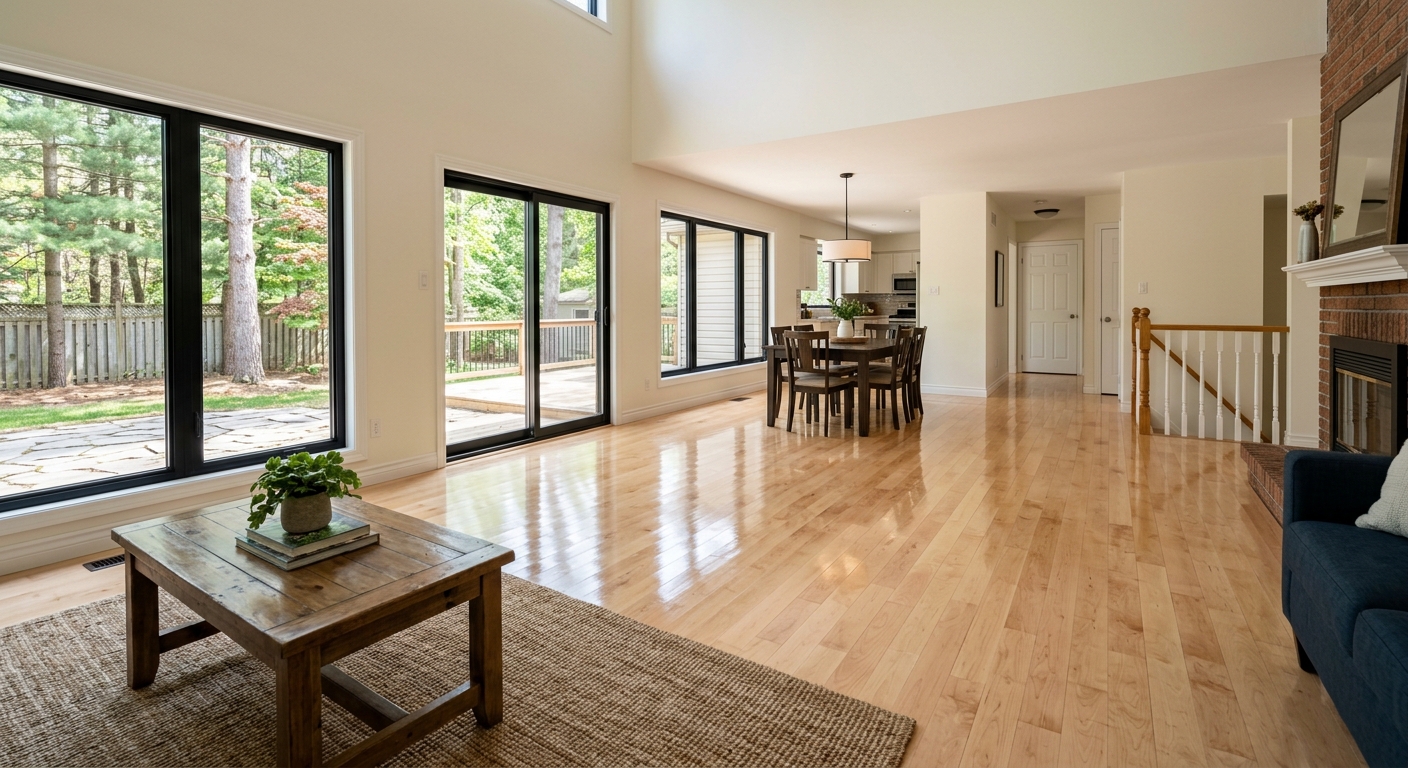
Flooring options and costs in Telkwa
Telkwa is where flooring decisions are really about matching materials to a demanding Nechako climate. With 41.1% of homes built before 1981, many local retrofits start with older subfloors that need levelling, repairs, or moisture mitigation before any finish is installed. That prep work is one reason your quote for the “same” floor can move quickly once a contractor measures low spots, checks for dampness, and plans transitions. Nechako humidity swings—dry winter indoor air followed by more humid shoulder seasons—also affect how products behave over time, especially near exterior walls and around basements.
Availability matters too: in smaller centres and rural stretches around Smithers and the Bulkley-Nechako corridor, crews may travel farther, and that shows up in labour and scheduling. In Telkwa specifically, trades often see extra demand in older neighbourhood pockets near the Bulkley River drainage areas, where humidity control and subfloor condition are common talking points during site visits. If you’re planning to add flooring over a slab-on-grade or a finished basement, contractors typically steer homeowners toward engineered wood or luxury vinyl plank (LVP) rather than thick solid hardwood, because moisture tolerance is the deciding factor below grade. For radiant-heat homes, most Telkwa renovations also favour radiant-compatible products such as engineered wood, quality LVP, or tile.
Below is a realistic starting point for commonly requested flooring types, so you can compare materials apples-to-apples before you ask for a site-specific measurement and quote.
| Type |
Best Room |
Moisture Resistance |
Lifespan |
Price per sq ft |
| Solid hardwood (nail-down, above grade only) |
Living / dining (above grade) |
Low to moderate (humidity sensitive; not for basements) |
25–50 years (when conditions are stable) |
$14–$25 |
| Engineered hardwood (float or glue, above + on-grade) |
Living areas, hallways, bedrooms |
Moderate to good (better with seasonal movement) |
20–35 years |
$12–$22 |
| Laminate (click-lock, above-grade) |
Bedrooms, offices, hallways |
Low to moderate (edge swelling if water gets in) |
10–25 years |
$4–$8 |
| Luxury vinyl plank / LVP (waterproof, any level) |
Kitchen, mudroom, finished basements |
High (waterproof surface; tolerant of movement) |
15–25 years |
$6–$13 |
| Porcelain / ceramic tile |
Kitchen, bathrooms, foyers |
Very high (properly installed with correct underlayment) |
25–50 years (grout maintenance required) |
$12–$25 |
| Carpet (broadloom or modular tile) |
Master bedroom, stairs |
Moderate (avoid below grade unless moisture plan is in place) |
8–15 years |
$10–$20 |
Prices are estimates only and vary by project scope, site access and material selection.
What affects the price of flooring in Telkwa
In Telkwa and across the Nechako region, quotes for the same room can differ by 30–50% depending on what’s happening under your current floor. The “headline” material cost can look similar, but the real budget drivers are subfloor condition, moisture control, and how the installation method fits your home. In British Columbia’s colder zone, indoor humidity swings and colder exterior envelope exposure can cause solid hardwood to expand/contract. Solid hardwood also cannot be installed over concrete or used safely in basements, so projects with slab or below-grade areas often shift toward engineered wood or LVP. Those product changes can increase the baseline price, but they prevent costly callbacks.
Radiant heat is another local pricing divider. Many renovations in the region incorporate radiant heat, so you typically need radiant-compatible flooring and a system setup that won’t trap excessive heat or lead to lock-joint failures in laminate. That’s why Telkwa homeowners are often steered toward engineered hardwood or quality LVP, and away from thick solid hardwood. Older housing stock matters, too: with 41.1% of homes built before 1981, it’s common to budget for subfloor levelling, repair, or moisture mitigation—often adding $1–$4 per sq ft before the finish goes down.
Two practical Telkwa examples: (1) a “same-size” living room can cost more when the contractor needs self-levelling compound because the floor is wavy or has patched OSB, even if the finish choice stays in the $12–$22 range for engineered; (2) a basement switch from solid wood to LVP can look like a price change, but waterproof LVP commonly reduces risk in below-grade moisture environments compared with trying to make a wood solution work. If tile is selected instead, the $12–$25 band is usually justified by surface durability and cleaning ease in kitchens, but it can cost more if your subfloor needs additional preparation.
| Price Factor |
Why It Matters |
Cost Impact |
| Room area in sq ft |
Directly drives material quantities, waste factor, and labour time |
Typically the biggest swing—larger areas scale costs predictably |
| Subfloor condition |
Levelling or repair is often required for a flat, quiet installation |
Often adds $1–$4 per sq ft depending on fixes needed |
| Moisture / below-grade install |
Solid hardwood cannot handle below-grade moisture; surface and vapour planning matters |
May shift you to engineered or LVP; typically increases risk management costs |
| Material choice |
Solid vs engineered vs LVP vs tile have different requirements and complexity |
Can move you from roughly $4–$8 (vinyl/laminate band) up to $12–$25 (tile/hardwood band) |
| Removal and disposal of existing flooring |
Demo time, disposal fees, and underlayment removal affect labour hours |
Commonly adds a noticeable line item, especially with glue-down remnants |
| Stair nosing / transitions |
Transitions and stair work are detail-heavy and may require custom trims |
Often charged per step or per linear foot; can add significant cost |
| Radiant heat compatibility |
Not all products tolerate heat transfer and temperature cycling |
May require specific underlay and product selection; reduces options but avoids failures |
| Installation method |
Float vs glue-down vs nail-down changes labour and subfloor requirements |
Glue-down and nail-down can cost more due to extra prep and fastening steps |
Permits & regulations in British Columbia
In British Columbia, a typical flooring installation does not require a building permit by itself. Replacing flooring with an approved finish—like engineered hardwood, LVP, laminate, carpet, or tile over an existing subfloor—usually falls under normal renovation work. However, associated work can trigger permitting depending on what else you’re changing. For example, if the job involves in-floor heating circuits (electrical connections, thermostat wiring, or modifying the electrical feed), an electrical permit and work by an appropriate electrical contractor are usually required. If you’re doing structural subfloor repairs, addressing rot, or making significant changes that affect building elements, permit requirements can become more nuanced—so it’s best to ask your contractor to identify what portions of the scope may need permits before work starts.
In condominiums, the corporation’s rules for sound transmission are often the bigger constraint than permits. Hard flooring on upper floors may be restricted or require specific underlay and installation methods to meet declared sound requirements (often referenced via STC/IIC targets). Before installing hardwood or tile above grade in a multi-unit building, review the condo declaration and obtain board approval in writing if your unit requires it.
For a Telkwa homeowner verifying a British Columbia contractor, start by confirming the company’s trades licensing (where applicable), then request proof of liability insurance and WSIB/WCB coverage. Ask for a certificate of insurance listing the correct legal name and address of the employer, and if they provide it, request a clearance letter or the current WCB/WSIB status document for their workers. Finally, confirm the contractor’s licence details using the official online registry search available in BC, and keep copies in your project file.
Best flooring for each room in your Telkwa home
Choosing the right flooring in Telkwa is about balancing traffic comfort, cleaning needs, and moisture risk—especially with Nechako humidity swings and the reality that many older homes have uneven subfloors. For living and dining areas, engineered hardwood or high-quality laminate usually hits the sweet spot: they bring warmth without the humidity sensitivity that can make solid hardwood problematic in real-world BC seasonal cycles. In bedrooms, carpet is a strong comfort choice and also helps with sound absorption in homes where winter heating is running constantly.
In kitchens, think “spills and splash zones.” Luxury vinyl plank (LVP) with a waterproof core is a practical winner because it tolerates wet wiping and minor accidents better than wood-based floors. Large-format porcelain tile is also excellent where you want maximum durability, but it can cost more once you include extra subfloor prep to keep it flat for thinset. For basements (especially finished ones), LVP is typically the safest default: its waterproof construction tolerates below-grade moisture better than solid hardwood and most laminate systems. Bathrooms should be porcelain or ceramic tile only, with proper waterproofing and grout selection.
If you have (or plan for) radiant heat, confirm compatibility before you buy. Radiant systems are increasingly common in British Columbia new construction and retrofits, and they reward properly rated underlay and flooring selections. A real budgeting example: if your option list includes laminate at roughly $4–$8 per sq ft versus engineered at about $12–$22 per sq ft, the extra cost is most justified in high-traffic rooms or where humidity control is tougher along exterior walls—rather than in low-use closets or short hallway stretches.
| Room |
Best Material |
Why |
Moisture Risk |
Price Band per sq ft |
| Living / dining room |
Engineered hardwood |
Warm feel with better seasonal stability than solid; good for fluctuating indoor humidity |
Low (above grade), medium near exterior walls without careful acclimation |
$12–$22 |
| Master bedroom |
Carpet or engineered hardwood |
Carpet adds comfort and sound dampening; engineered keeps a cleaner, harder surface option |
Low (above grade); watch for any chronic humidity or leaks |
$10–$20 |
| Secondary bedrooms |
Laminate (click-lock) or engineered |
Laminate fits budget; engineered improves longevity in busy households |
Low to medium (edge swelling if water gets in at seams) |
$4–$16 |
| Kitchen |
Luxury vinyl plank (LVP) or porcelain tile |
LVP handles everyday spills; tile offers maximum cleaning durability |
Medium to high (water and grease exposure) |
$6–$25 |
| Basement (finished) |
Luxury vinyl plank (waterproof) |
Designed for moisture-tolerant, below-grade environments and reduces risk of cupping/gapping |
High (vapour and occasional dampness under slabs or at perimeter walls) |
$6–$13 |
| Bathroom |
Porcelain / ceramic tile |
Non-absorptive, durable surfaces when installed with correct waterproofing/underlayment |
Very high (direct water exposure) |
$12–$25 |
How to choose a flooring contractor in Telkwa
Start by verifying the contractor’s British Columbia coverage and ability to do the work safely and legally. Ask for (1) liability insurance—so you’re protected if a worker damages property; (2) WSIB/WCB coverage—so your project isn’t exposed if someone is injured onsite; and (3) proof of the correct licensing/credentials where applicable for the company and any related trades they coordinate. In practice, you’ll typically request a certificate of insurance and confirm the employer name matches the quote contract. For WSIB/WCB, request the current clearance letter or documentation that shows the account is in good standing for the installing workers.
Next, get 2–3 itemised written quotes with a clear labour + materials breakdown (not a lump sum). You want line items for prep/levelling, moisture mitigation, underlay, installation method, transitions, stair work, and removal/disposal. Read exclusions carefully: confirm whether the quote includes moving furniture, subfloor repairs, acclimation time, and whether permit pulls are needed for any electrical work related to radiant heating. Ask about the disposal plan—dump fees and haul-away can be a hidden cost if it’s not spelled out. Then review warranty terms: workmanship warranty length, the product/manufacturer warranty (and what voids it), and whether any coverage is transferable if you sell the home.
Finally, payment schedule matters. Never pay more than 10–15% upfront; hold back a portion until the job is complete and you’ve had a chance to inspect transitions, edge conditions, and any punch-list items. In Telkwa, timelines are weather-affected, so insist on the start date and an estimated completion date in writing. If a contractor can’t commit to dates, or won’t explain what could change the schedule, that’s usually a warning sign.
- Request the contractor’s legal business name and verify it matches the insurance certificate.
- Ask for liability insurance details (policy number and expiry date) before you sign.
- Confirm WSIB/WCB coverage for installers (request a clearance letter or proof of standing).
- Get 2–3 itemised quotes with labour and materials separated.
- Ensure the quote lists subfloor levelling/repair amounts and whether self-levelling is included.
- Confirm underlay and vapour-control details (especially for LVP and any radiant-heat areas).
- Ask if acclimation time is included for engineered wood or laminate.
- Specify transition pieces and stair nosings (charged per step or linear foot should be listed).
- Verify removal and disposal is included, including underlayment glue/edge stripping.
- Clarify exclusions: damaged drywall/trim, inaccessible areas, pre-existing moisture issues.
- Confirm warranty terms in writing: labour warranty length and manufacturer warranty conditions.
- Lock the payment schedule: 10–15% max upfront, with holdback until punch list completion.
Red flags I see in Telkwa: quotes that don’t mention subfloor flatness checks, no discussion of humidity acclimation, vague warranty language, “cheap” LVP installs without a proper underlay/vapour plan, and contractors who won’t provide proof of liability insurance or WSIB/WCB documentation on request.
Frequently asked questions — flooring in Telkwa
What flooring is best for a Telkwa basement?
For most finished basements in Telkwa, luxury vinyl plank (LVP) is the safest choice because it’s waterproof on the surface and tolerates below-grade moisture conditions better than wood-based floors. The Nechako region’s indoor humidity swings and the way moisture vapour can move through slabs or perimeter walls means solid hardwood can gap or cup, especially if conditions aren’t tightly controlled. Many homeowners also benefit from LVP’s flexibility over slightly uneven subfloors, though it still needs a flat base. If your basement is truly dry and well-sealed, engineered wood may work in some on-grade setups, but I typically reserve that for situations where moisture measurements and site conditions support it. If you’re comparing budgets, LVP commonly falls in the $6–$13 per sq ft band, while tile can run $12–$25 depending on prep.
Can I install hardwood over concrete?
In most cases in British Columbia—including Telkwa—you shouldn’t install solid hardwood over concrete. Solid hardwood is sensitive to humidity and movement and isn’t designed for direct slab conditions; it also can’t be glued or floated to concrete the same way engineered flooring can. Engineered hardwood is the more realistic option if the concrete slab is properly prepared, flat, and dry enough for the system being used. Even then, contractors should address moisture mitigation (and vapour control if required) and confirm the installation method is appropriate for your product. For radiant-heat homes, the flooring and underlay need to be compatible with temperature cycling. If you’re priced around the $12–$22 per sq ft engineered band, it’s often worth it compared with trying to force a solid hardwood approach over slab conditions.
How long does flooring installation take?
Timelines vary by area, subfloor prep, and whether you’re removing old flooring, but a typical Telkwa project can range from a couple of days for smaller, straightforward rooms to a week or more for multi-room work. The schedule usually extends when levelling, moisture mitigation, or repair is needed—especially in older homes where uneven subfloors are common. With 41.1% of local dwellings built before 1981, it’s not unusual for a contractor to spend extra time on underlayment removal, flattening, and transitions before laying the finish. Another factor is product acclimation for engineered wood and laminate. If your project includes stairs, custom transitions, or radiant-heat changes (electrical coordination), plan additional time for those details. Ask your contractor for a written start date and completion estimate that includes prep time, not just installation day counts.
What flooring works with radiant heat?
In Telkwa and across British Columbia, the best radiant-heat partners are usually engineered hardwood, quality LVP, and properly specified tile. The key is compatibility—both the flooring and underlay must be rated for radiant systems so heat transfer is controlled and expansion/contraction doesn’t lead to joint separation or movement issues. Many radiant installations also require careful attention to subfloor flatness and installation method (for example, using the correct thinset and underlayment build-up for tile). Solid hardwood is often limited because of humidity and temperature sensitivity; some products may not be recommended over radiant systems. If your quote is in the engineered $12–$22 per sq ft range or the LVP $6–$13 per sq ft range, that’s often where radiant-compatible options land for real-world projects. Always confirm the product model’s radiant rating in writing before you commit.
Engineered vs solid hardwood — what's the difference?
Solid hardwood is a single piece of wood (typically nail-down in residential applications) and is much more sensitive to humidity and temperature cycling. In Telkwa’s climate—where indoor humidity swings can be noticeable—solid wood is generally limited to above-grade rooms with stable conditions. Engineered hardwood is built in layers, which makes it more dimensionally stable, so it handles seasonal movement better and can be installed in more situations (often including certain on-grade floors). That’s why many Nechako-area renovations that face basements, slab conditions, or radiant heat end up with engineered instead of solid. Price-wise, solid hardwood commonly lands around $14–$25 per sq ft, while engineered hardwood is often in the $12–$22 per sq ft band depending on wear layer thickness and brand. The better product for you depends on where it’s going, not just the look.
Do I need to level my subfloor first?
Most of the time, yes—at least to the extent required for your flooring type. Level/flat subfloors are essential in British Columbia because small dips and high spots become visible, create noise, and can lead to joint failure in floating floors. In Telkwa homes built before 1981, uneven subfloors are common, so contractors frequently include levelling or repair to get a consistent surface before installing engineered wood, laminate, LVP, or tile. The cost can also be meaningful: levelling work often adds around $1–$4 per sq ft depending on what’s needed. LVP can tolerate minor irregularities better than rigid tile, but it still requires proper prep for a long-lasting, quiet install. If your contractor won’t measure flatness or discuss the prep steps in the written scope, ask directly—this is one of the biggest drivers of whether your floor stays tight for years.