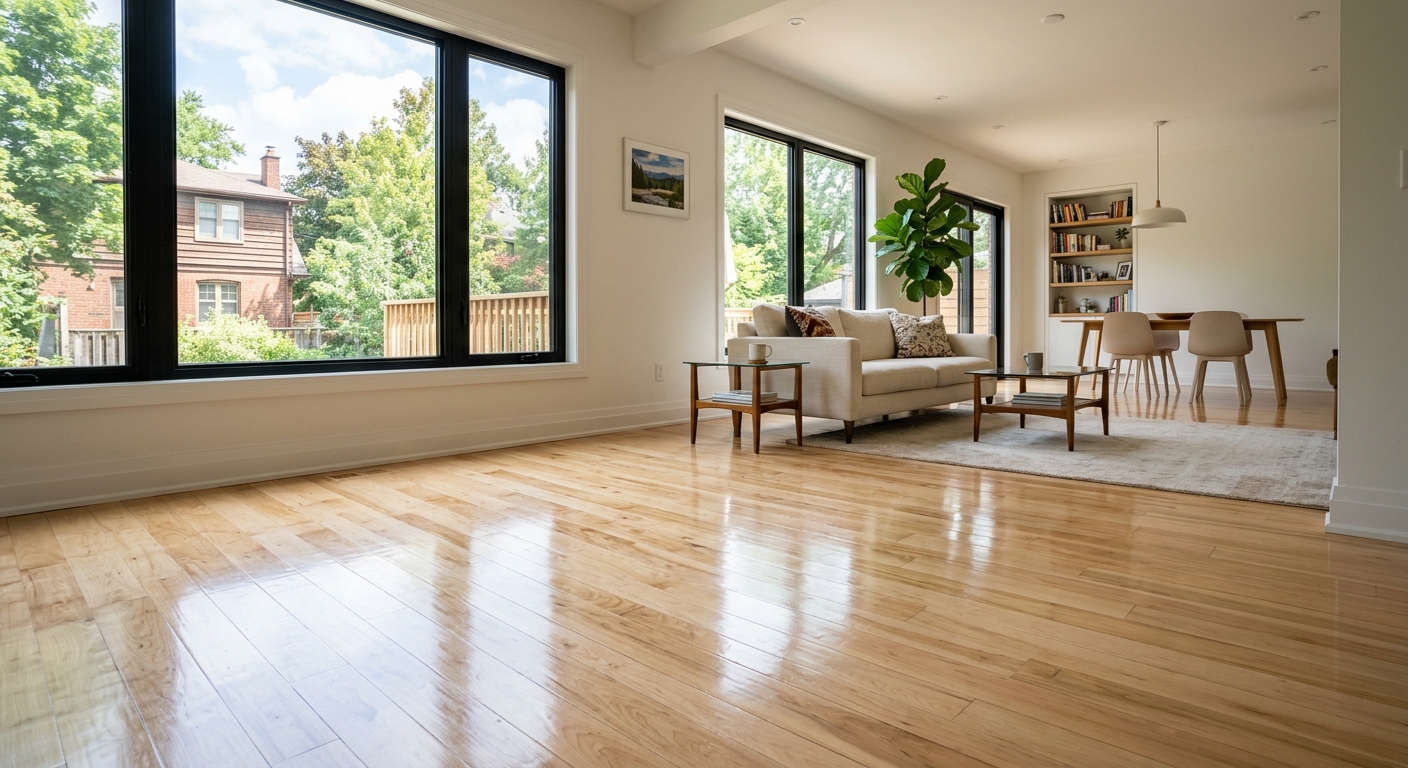
Flooring options and costs in Hanover
Hanover is a great place to update flooring, but the cost can swing because so many homes here are older. In fact, 64.2% of dwellings were built before 1981 (Statistics Canada, 2021 Census), which often means subfloors are out of level, worn OSB and plywood show up, and you may need levelling/repair before any new finish goes down. That prep work is a major reason the “same” floor can come back with a higher total installed price than homeowners expect.
On the Stratford–Bruce Peninsula side of Ontario, contractors also price differently because of wide indoor humidity swings between winter and summer, plus basement moisture. Solid hardwood can respond by gapping, cupping, or swelling if the humidity isn’t consistent, and it’s not a good fit for below-grade areas. That’s why we typically steer basements and higher-humidity zones toward engineered wood or luxury vinyl plank (LVP), both of which tolerate moisture better than solid wood. When radiant floor heating is present (it’s increasingly common in renovations), we also have to choose products that are compatible with temperature cycling—another reason radiant-compatible engineered wood, LVP, many tiles, and some high-density laminates often price more realistically than certain low-end options.
In Hanover, this trade is especially busy in neighbourhoods like Durham Ward and the downtown-to-river corridor, where many homes are older and basement upgrades are common. Next, here’s a practical comparison of flooring types and typical cost ranges for installed projects.
| Type |
Best Room |
Moisture Resistance |
Lifespan |
Price per sq ft |
| Solid hardwood (nail-down, above grade only) |
Main living areas on the first floor |
Low–Moderate (humidity sensitive) |
20–35 years |
$10–$18 |
| Engineered hardwood (float or glue, above + on-grade) |
Main floors and hallways |
Moderate–High |
15–30 years |
$11–$18 |
| Laminate (click-lock, above-grade) |
Bedrooms, living rooms (dry zones) |
Moderate (not for basements) |
10–20 years |
$4–$10 |
| Luxury vinyl plank / LVP (waterproof, any level) |
Kitchens, mudrooms, basements |
High–Very High (waterproof) |
15–25 years |
$5–$12 |
| Porcelain / ceramic tile |
Bathrooms, kitchens, foyers |
Very High |
25–50 years |
$12–$22 |
| Carpet (broadloom or modular tile) |
Bedrooms, family rooms |
Low (can hold odours/retains moisture) |
8–15 years |
$5–$11 |
Prices are estimates only and vary by project scope, site access and material selection.
What affects the price of flooring in Hanover
In Hanover and across the Stratford–Bruce Peninsula economic region, you’ll often see quotes for the same flooring “brand and square footage” differ by 30–50%. The biggest reason isn’t just the material—it’s the reality of older subfloors, moisture management, and whether your project includes radiant-compatible prep and underlayment.
First, humidity swings and below-grade moisture are the key technical drivers here. Solid hardwood expands and contracts with seasonal humidity, and it can’t be glued or floated over concrete; in practice, it performs poorly in basements where moisture vapour is more likely. Engineered hardwood and LVP handle humidity and below-grade applications far better, but the right product still needs correct underlayment and subfloor condition. Second, older housing stock frequently needs levelling or repair. When we’re called into homes built before 1981 (64.2% of dwellings locally) (Statistics Canada, 2021 Census), that prep can add roughly $1–$4 per sq ft for repairs, patching, or new underlayments, before we ever set a single plank.
In concrete examples: if your living area is out of level by even 1/4 inch over a small section, levelling compound can turn a $4–$10/sq ft laminate plan into a higher total project cost than people expect. Or, if the basement has a history of dampness, switching from solid hardwood to LVP can raise upfront material cost, but it prevents the expensive call-back costs that come with cupping and gaps. Also, radiant floor heating often makes certain solid hardwood installs off the table, and that can shift you into engineered wood or tile—typically aligning with the $10–$18 and $12–$22 backbone bands for those materials.
| Price Factor |
Why It Matters |
Cost Impact |
| Room area in sq ft |
More surface means more labour time, more underlayment, and more material waste allowance. |
Directly proportional; larger areas often price more efficiently per sq ft |
| Subfloor condition |
Old subfloors may need levelling, patching, or replacement to get a stable, flat base. |
Commonly adds about $1–$4 per sq ft for repair/levelling in older homes |
| Moisture / below-grade install |
Basements and on-grade slabs need moisture-tolerant assemblies; solid wood is often ruled out. |
Can add vapour barriers and moisture testing; may push you to engineered wood or LVP |
| Material choice |
Solid vs. engineered vs. LVP vs. tile changes both material rate and underlayment requirements. |
Biggest swing: e.g., LVP around $5–$12 vs tile around $12–$22 per sq ft |
| Removal and disposal of existing flooring |
Pulling up old flooring, nails/glue residues, and hauling debris increases labour and dump fees. |
Often adds a separate line item that can meaningfully raise total project cost |
| Stair nosing / transitions |
Steps and custom transitions take time and must handle height differences safely. |
Charged per step or per linear foot; can add notable cost on stairs-heavy homes |
| Radiant heat compatibility |
Some solids and low-end laminates can’t handle temperature cycling properly. |
May increase material costs and limit options to radiant-compatible engineered/LVP/tile |
| Installation method |
Float, glue-down, or nail-down each has different prep and labour requirements. |
Glue-down and nail-down generally require stricter subfloor prep than simple click-lock |
Permits & regulations in Ontario
In Ontario, flooring installation itself usually does not require a building permit. You typically don’t need a permit to replace finishes like engineered hardwood, LVP, laminate, carpet, or ceramic tile when you’re only working on non-structural floor surfaces. However, associated work can trigger permit requirements.
Work that may require permits includes structural subfloor work (for example, replacing joists or doing structural repairs), moisture remediation that involves substantial changes to drainage/separation systems, and anything tied to in-floor heating circuit work that intersects with electrical components. If radiant heating is being installed or modified, that electrical portion may require a permit and installation by a licensed electrical professional.
Work that typically does NOT require permits includes removing existing flooring, installing underlayments, levelling compound over existing subfloors (non-structural), gluing or floating engineered flooring on an approved surface, and standard tile installations (even when tied to radiant-compatible products), as long as you’re not altering structural members or electrical circuits.
For condominiums in Ontario, check the corporation’s rules for sound transmission (STC/IIC) and any underlay requirements. For multi-unit buildings, request board approval in writing before installing hard-surface floors like hardwood or tile on upper levels. Finally, when hiring in Hanover, verify the contractor’s Ontario licence (if applicable to their trade scope), WSIB/WCB coverage, and liability insurance. Ask for the certificate of insurance (COI) copy and a clearance letter, and confirm the coverage expiry date—then keep it with your contract documentation.
Best flooring for each room in your Hanover home
Choosing flooring in Hanover means matching the material to moisture behaviour, foot traffic, and comfort—especially given Stratford–Bruce Peninsula humidity swings and basement moisture. For living and dining spaces, engineered hardwood or high-quality laminate are common picks because they deliver a warm look while managing seasonal movement better than solid wood. In the master bedroom, carpet is still a winner for comfort and sound absorption, but if you want a uniform finish, engineered hardwood is a strong alternative.
Kitchens take the most abuse from spills and routine cleaning, so luxury vinyl plank (LVP) or large-format porcelain tile are usually the best performers. LVP is particularly practical in Hanover because it’s waterproof and tolerates the kind of indoor humidity changes that can trouble wood-based products. For basements (finished), LVP is the clear choice: it handles below-grade moisture vapour and is far less likely to cup or swell than solid hardwood. Bathrooms should be porcelain or ceramic tile only—water resistance is non-negotiable.
Radiant floor heating is popular in Ontario renovations, and it changes what’s “best.” Products must be compatible with temperature cycling. In most cases, that favours engineered wood, LVP, many tiles, and some higher-density laminates. Solid hardwood is often restricted to above-grade installs for reliability, especially where the home’s humidity isn’t tightly controlled.
As a dollar example: moving from laminate ($4–$10 backbone) to LVP ($5–$12 backbone) for a kitchen can cost more upfront, but it’s often justified because it reduces fear of moisture damage from sinks, wet mopping, and seasonal basement humidity drift that can migrate into adjacent open areas.
| Room |
Best Material |
Why |
Moisture Risk |
Price Band per sq ft |
| Living / dining room |
Engineered hardwood |
Warmth and realism with better humidity tolerance than solid; works well with typical first-floor conditions. |
Low–Moderate (humidity swing can still move seams) |
$10–$18 |
| Master bedroom |
Carpet or engineered hardwood |
Carpet adds comfort and sound dampening; engineered wood gives a cleaner, hypoallergenic look. |
Low |
$5–$18 |
| Secondary bedrooms |
Laminate (higher-density) or carpet |
Good balance of budget and durability for bedrooms with less moisture exposure. |
Low |
$4–$10 |
| Kitchen |
Luxury vinyl plank (LVP) or large-format porcelain tile |
Easy cleanup and strong spill performance; radiant-compatible options are typically available. |
Moderate (spills and cleaning water) |
$5–$22 |
| Basement (finished) |
Luxury vinyl plank (LVP) waterproof |
Best tolerance for below-grade moisture vapour; helps avoid cupping and swelling issues common with solid wood. |
High |
$5–$12 |
| Bathroom |
Porcelain / ceramic tile |
Superior water resistance and longevity; handles steam and wet conditions better than wood or LVP in wet-zone details. |
Very High |
$12–$22 |
How to choose a flooring contractor in Hanover
When you’re hiring a flooring contractor in Hanover, verify three things early: Ontario licensing (as applicable to the scope), liability insurance, and WSIB/WCB coverage. Ask to see a current certificate of insurance and confirm the COI includes general liability appropriate to flooring installation activities. For WSIB/WCB, request proof and check it’s active for the installer(s) assigned to your project. If they can’t provide documentation quickly, that’s a strong indicator to keep looking.
Next, get 2–3 itemised written quotes that break out labour and materials separately. A good quote shows underlayment/vapour barrier, levelling/patching (if needed), stair nosing and transitions, removal and disposal, and any radiant-compatible prep. Avoid “lump sum” quotes that don’t show what’s included—especially around moisture control, which is a cost driver in Hanover basements and on-grade installs. Confirm whether disposal is included, whether subfloor levelling is included (and to what standard), and whether permits are required for any adjacent work.
Warranty matters too. Ask for the workmanship warranty length and whether it’s transferable to future owners. Also confirm the product/manufacturer warranty conditions for installation method and humidity requirements. Payment schedule: never pay more than 10–15% upfront; hold a portion until the job is complete and you’ve inspected transitions, edges, and any stair details. Finally, get the start date and completion estimate in writing, including what happens if deliveries arrive late or subfloor prep uncovers damage.
- Ask for WSIB/WCB clearance/proof and confirm coverage is active for the crew.
- Request a COI (certificate of insurance) for liability and keep a copy.
- Confirm they’ve done installs that match your situation (basement moisture, radiant heating, above-grade solid vs engineered).
- Get quotes that specify underlayment, vapour barriers, and levelling compound/patching.
- Verify removal and disposal is included (and whether hauling fees are separate).
- Check what transitions and stair nosing costs include (per step vs per linear foot).
- Ensure the scope states room-by-room square footage and waste allowance.
- Ask about dust control for prep and how they protect stairs/trim and HVAC vents.
- Confirm subfloor flatness targets and how they’ll measure before installation.
- Ask whether acclimation of materials is required and for how long.
- Review warranty terms for both workmanship and product, including exclusions for moisture.
- Use a payment schedule with a holdback until final walkthrough.
Red flags in Hanover: quoting only “per square foot” with no line items for levelling/moisture prep, refusing to show insurance/WSIB documentation, promising a solid hardwood basement install, starting work before confirming subfloor condition, and giving a short warranty or vague dates for completion.
Frequently asked questions — flooring in Hanover
What is the difference between floating and glued-down flooring?
In Hanover homes, the terms “floating” and “glued-down” describe how the flooring is attached to the subfloor. Floating floors (typical click-lock laminate and many LVP systems) sit on top of an underlayment pad and do not get bonded to the subfloor. Because they’re not rigidly fixed, floating installations can better tolerate minor movement from humidity swings—important in the Stratford–Bruce Peninsula area. Glued-down flooring (common with certain LVPs and some engineered products) is bonded directly, which can improve stability when installed over a properly prepared surface. However, glue-down requires stricter subfloor flatness and correct moisture conditions. If you’re dealing with below-grade moisture in a basement, we usually steer clients to waterproof LVP systems rather than rigid glue-down hardwood methods.
What flooring holds up best to pets in a Hanover home?
For pets in Hanover, LVP is often the most practical choice because it’s waterproof and resists staining from typical spills and accidents. It also tends to handle daily paw traffic and doesn’t suffer from the same cupping/gapping risk that solid hardwood can face when indoor humidity swings. If you prefer a softer feel, carpet can work, but you’ll want stain-resistant fibre and prompt cleaning practices—basements or damp areas are less forgiving. Laminate can be durable, but it’s vulnerable if liquid sits at seams. In terms of price, LVP commonly falls in the $5–$12 per sq ft backbone band, while carpet installation is typically $5–$11 per sq ft. For many pet-owning households, the extra reliability is worth the modest material difference, especially when you want one consistent finish through active family areas.
How do I fix squeaky floors in my Hanover home?
Squeaks are usually a subfloor and fastener issue, not the finish flooring itself. In Hanover’s older housing stock (64.2% built before 1981) (Statistics Canada, 2021 Census), it’s common to find movement between joists, loose subfloor sheets, or nails that have worked loose over time. The right fix is to identify where the noise occurs (from the top side and sometimes from below in a crawl space/basement) and then re-secure the subfloor to joists with approved fasteners. Sometimes adding a layer of appropriate underlayment or subfloor paneling is part of the correction, but we don’t “hide” squeaks under flooring without addressing the cause. If you’re installing over an uneven or damaged base, levelling and repair become essential before any new click-lock or tile work. A contractor should include subfloor inspection in the scope rather than assuming the floor finish will solve it.
What is luxury vinyl plank and is it worth it in Hanover?
Luxury vinyl plank (LVP) is a vinyl flooring designed for looks like wood, but built for real-life moisture and traffic. In Ontario—especially in the Hanover area where there are wide indoor humidity swings and basement moisture concerns—LVP is often worth it because many products are fully waterproof and tolerate below-grade conditions better than solid hardwood and most standard laminate. That moisture tolerance reduces the risk of cupping, swelling, and costly callbacks. LVP also works well with radiant heat when you choose a radiant-compatible product and underlayment assembly. In cost terms, LVP typically fits the $5–$12 per sq ft backbone band for flooring and installation. If you compare that to solid hardwood at $10–$18 per sq ft, the value usually shows up when you need moisture-safe performance in a basement or kitchen, or when your subfloor prep is already extensive.
How much does flooring cost in Hanover?
In Hanover, total flooring costs depend on product type, prep, and whether moisture control and levelling are needed. As a budgeting guide using local backbone price bands, hardwood flooring is commonly $10–$18 per sq ft, while laminate/LVP are often in the $4–$10 and $5–$12 per sq ft ranges respectively. Tile usually lands around $12–$22 per sq ft, and carpet installation is commonly $5–$11 per sq ft. However, older homes frequently need more prep: repairs and levelling can add about $1–$4 per sq ft in many projects, which is why one quote for “1,000 sq ft of laminate” can come back significantly higher than another. If radiant heating is present, you may also need radiant-compatible products, which can shift you toward engineered wood or LVP/tile options. For an accurate number, insist on an itemised quote that includes removal/disposal and subfloor prep.
Hardwood vs laminate vs vinyl plank — which is best?
“Best” depends on where you’re installing and how much moisture risk you have. Hardwood (especially solid nail-down) is beautiful, but in Hanover’s climate and housing age profile it’s usually best for above-grade rooms only. Solid hardwood is humidity sensitive and isn’t a great fit for basements, which is important because many local homes are older and more likely to have below-grade moisture challenges. Laminate is budget-friendly (often $4–$10 per sq ft), but it’s not the first choice for basements and it can be damaged if water gets into seams. Vinyl plank (LVP) is typically the most forgiving in kitchens and basements because many waterproof products can handle moisture and cleaning better—often in the $5–$12 per sq ft backbone band. If you want the most reliable overall performance across the home, LVP is usually the safest pick in Hanover. If you want a premium look above grade, engineered hardwood is often the best compromise.