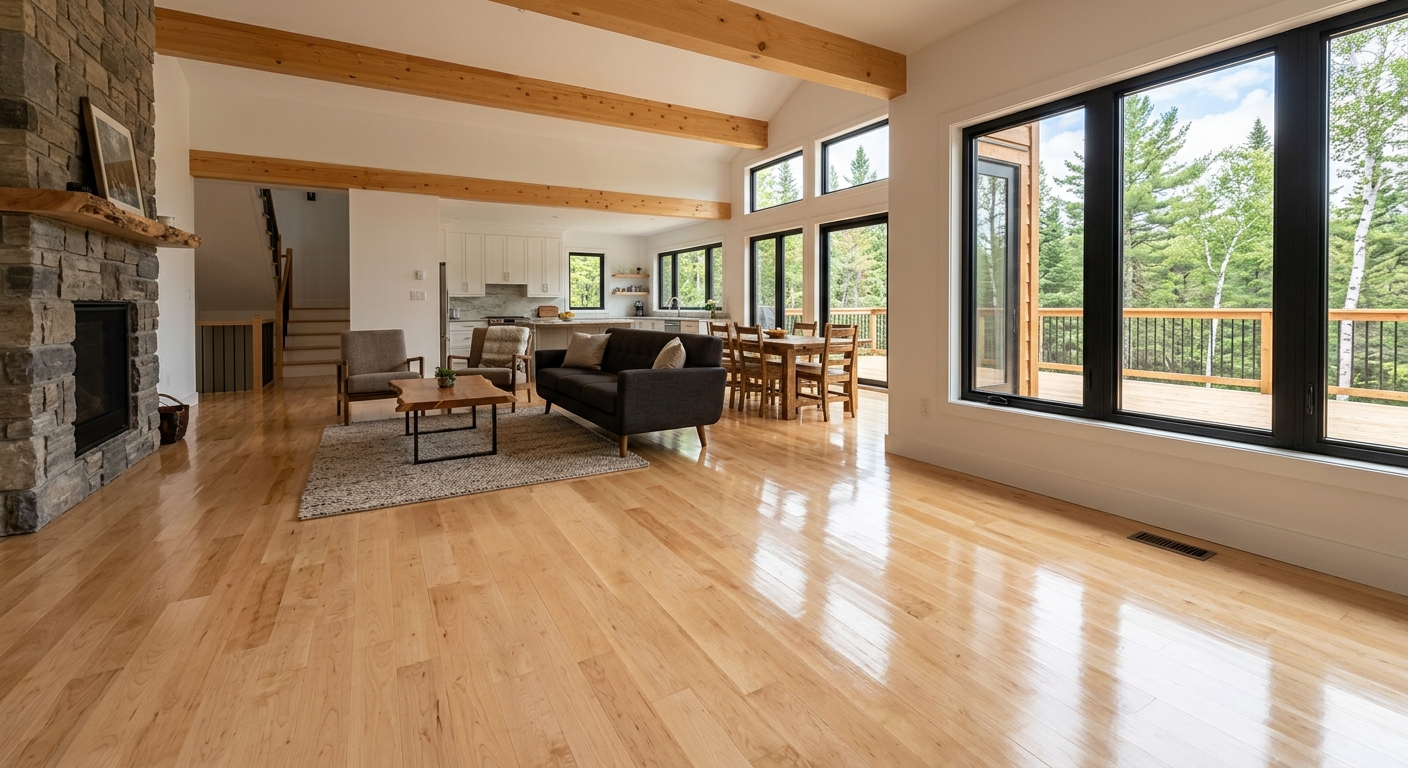
Flooring options and costs in Thorncliffe Park
Thorncliffe Park is a great place to plan a flooring upgrade, but your budget will depend on the kind of home you’re in—especially the moisture swings you get around Toronto. With a population of 21,108 in the Thorncliffe Park area (Statistics Canada, 2021 Census), there’s steady demand from homeowners and landlords, and that translates into busy install schedules for contractors in the Toronto labour market. Many local residences fall into the “renovation-ready” category, where older subfloors are commonly uneven; in practice, that means you often budget for subfloor levelling or repair before new flooring goes down. In Thorncliffe Park, that prep work can add roughly $1–$4 per sq ft depending on whether it’s minor smoothing, plywood replacement, or a moisture mitigation layer.
Toronto-area humidity can swing widely between seasons, and that’s a key reason we steer many clients away from solid hardwood over concrete or in below-grade spaces. Solid wood looks premium, but it expands and contracts with humidity and is risky in basements and over slab without the right system. Engineered hardwood and luxury vinyl plank (LVP) are far more dimensionally stable for above-grade installs, and they’re specifically designed to handle below-grade environments and the higher moisture exposure you can see in older Toronto housing. If your reno includes radiant floor heating—common in newer infill and custom builds—those floor systems also influence the product selection and cost.
We see especially strong demand for flooring work around Coxwell Avenue and the Danforth corridor, where many homes are being updated block-by-block. Next, compare the typical material price ranges and suitability to narrow down what fits your rooms and your moisture risk.
| Type |
Best Room |
Moisture Resistance |
Lifespan |
Price per sq ft |
| Solid hardwood (nail-down, above grade only) |
Living rooms, dining rooms (dry areas) |
Low–Moderate (not for below grade) |
20–40 years |
$9–$18 |
| Engineered hardwood (float or glue, above + on-grade) |
Living rooms, bedrooms |
Moderate–High (handles humidity better) |
15–30 years |
$9–$16 |
| Laminate (click-lock, above-grade) |
Secondary bedrooms, hallways (dry areas) |
Low–Moderate (water can still reach seams) |
10–20 years |
$4–$9 |
| Luxury vinyl plank / LVP (waterproof, any level) |
Kitchen, finished basement, main floor with pets |
High (waterproof core options) |
15–25 years |
$5–$10 |
| Porcelain / ceramic tile |
Bathrooms, kitchens, entryways |
Very High |
25–50 years |
$12–$25 |
| Carpet (broadloom or modular tile) |
Bedrooms, stairs (comfort/sound) |
Low (can hold moisture if flooding occurs) |
7–15 years |
$5–$11 |
Prices are estimates only and vary by project scope, site access and material selection.
What affects the price of flooring in Thorncliffe Park
In Thorncliffe Park and the wider Toronto area, quotes for the same basic job can land 30–50% apart because the “hidden” parts of flooring work are often the real drivers: subfloor prep, moisture mitigation, removal, transitions, and how demanding the installation is. Two homes can have the same square footage, but one might need plywood replacement and the other might only need a quick level-check. Toronto’s market also tends to price labour higher than many other regions, since renovation demand stays strong and installer availability can tighten during peak season.
Technically, indoor humidity swings across seasons are a big reason you’ll see different options priced differently. Solid hardwood expands and contracts with humidity, and it cannot be glued or floated over concrete; it’s also risky in basements where moisture vapour is common. Engineered hardwood and LVP are more dimensionally stable and are built for the above + on-grade realities we see around the city, and for below-grade work where solid wood and many laminates struggle. In colder parts of the region and where radiant floor heating is used, certain products become better fits; that can add to cost when you’re selecting for heat compatibility.
Here are a few concrete Thorncliffe Park scenarios that change the number: if your subfloor is uneven, levelling or repair can add roughly $1–$4 per sq ft before any new material is laid. If you have to remove old carpet and haul disposal, that labour/disposal is often a separate charge. And if your choice is solid hardwood in a space with moisture risk, you may still pay for moisture mitigation—often reducing the value versus engineered hardwood in the $9–$16 range or LVP that typically sits closer to $5–$10 per sq ft.
| Price Factor |
Why It Matters |
Cost Impact |
| Room area in sq ft |
Material and labour scale directly with coverage and waste rate |
Higher sq ft usually lowers waste % but raises total cost |
| Subfloor condition |
Levelling, patching, or plywood replacement is often required for a flat base |
Can add about $1–$4 per sq ft in older Toronto homes |
| Moisture / below-grade install |
Below-grade moisture vapour limits solid hardwood; needs proper systems |
Solid hardwood can trigger extra prep; LVP often simplifies the risk |
| Material choice |
Solid vs engineered vs LVP vs tile varies in product cost and install method |
Typically shifts budgets across bands (e.g., $4–$9 laminate vs $9–$18 hardwood) |
| Removal and disposal of existing flooring |
Old flooring, underlay, and fasteners add time and disposal fees |
Commonly increases the quote even when material cost is mid-range |
| Stair nosing / transitions |
Steps and transitions require mouldings, matching heights, and extra cutting |
Often charged per step or per linear foot; adds quickly on stairs |
| Radiant heat compatibility |
Heat cycling needs materials rated for temperature changes |
May increase product cost and limit choices (especially for solid wood) |
| Installation method |
Float, glue-down, or nail-down affects labour time and prep |
Nail-down solid can cost more when subfloor and moisture conditions are demanding |
Permits & regulations in Ontario
In Ontario, installing new flooring as a standalone finish typically does not require a building permit. However, permits can come into play if your project includes work that changes electrical systems, structural elements, or in-floor heating circuits. For example:
- Often does NOT require a permit: removing old flooring, installing laminate click-lock, installing engineered hardwood (above grade), LVP, carpet, or tile as a finish layer—when no electrical or structural modifications are made.
- May require a permit (and inspections): running or modifying electrical circuits for radiant heating controls, any electrical work tied to in-floor heating, and situations involving structural subfloor replacement that is beyond typical “repair/level” (for example, significant structural changes).
For condo projects in Thorncliffe Park, the bigger practical rule is usually inside your building: sound transmission. Many corporations enforce specific underlay requirements to meet sound ratings and reduce impact noise. Before you install hardwood or tile on upper floors, request written board approval when required—especially for hard surface finishes.
To verify your contractor in Thorncliffe Park, do three checks before signing:
- Ontario licence / registration: confirm the contractor is properly registered for their work category using the applicable online registry information listed for Ontario.
- Liability insurance: ask for a current certificate of insurance naming you if required by the strata/landlord; confirm coverage dates and limits.
- WSIB/WCB coverage: ask for proof of coverage and/or a clearance letter if applicable; verify it’s current for the project start date.
Best flooring for each room in your Thorncliffe Park home
In Thorncliffe Park homes, the winning flooring choices are the ones that tolerate Toronto’s indoor humidity swings and the moisture vapour risks that show up in basements. Living and dining areas see steady foot traffic, so engineered hardwood is often a strong match: it brings warmth and a high-end look, but it handles humidity better than solid wood. In master bedrooms, you’ll usually choose between comfort and sound control (carpet) versus long-term durability (engineered hardwood). For most homeowners, carpet is a comfortable option for bedrooms, while still keeping maintenance manageable if humidity is controlled.
Kitchen floors take the most real-world abuse—spills, standing water, and frequent wet mopping. That’s why luxury vinyl plank (LVP) is a top choice, and why large-format porcelain tile is also popular: both clean easily and resist water. In basements (especially finished ones), LVP is the clear winner because it’s waterproof and designed for below-grade moisture conditions; solid hardwood and many laminate products can fail when moisture vapour migrates upward. Bathrooms are straightforward: porcelain or ceramic tile only for the floor finish due to sustained wet conditions.
If you have radiant floor heating (common in newer builds around the Toronto market), consider materials that are compatible with heat cycling. Engineered wood, tile, and certain vinyl systems are typically the safest pairings. The price difference can justify itself: for instance, if you’re deciding between laminate around $4–$9 per sq ft and LVP closer to $5–$10 per sq ft, that extra $1–$3 per sq ft is often worth it for basement moisture protection and fewer repair risks.
| Room |
Best Material |
Why |
Moisture Risk |
Price Band per sq ft |
| Living / dining room |
Engineered hardwood |
Warm look with better humidity tolerance than solid |
Low–Moderate (manage indoor humidity) |
$9–$16 |
| Master bedroom |
Carpet or engineered hardwood |
Carpet adds comfort and sound reduction; engineered lasts longer |
Low (if humidity is controlled) |
$5–$11 |
| Secondary bedrooms |
Laminate (click-lock) or LVP |
Laminate is cost-effective; LVP is safer if spills happen |
Low–Moderate |
$4–$9 |
| Kitchen |
Luxury vinyl plank (LVP) or porcelain tile |
Water resistance, easy cleaning, good for daily splashes |
Moderate (daily moisture exposure) |
$5–$25 |
| Basement (finished) |
LVP (waterproof) |
Handles below-grade moisture vapour better than wood/laminate |
High (vapour and seasonal humidity) |
$5–$10 |
| Bathroom |
Porcelain / ceramic tile |
Built for wet conditions; durable and cleanable |
High (standing water potential) |
$12–$25 |
How to choose a flooring contractor in Thorncliffe Park
Choosing the right flooring contractor in Thorncliffe Park is less about glossy photos and more about proof, process, and the details in the quote. Start by verifying Ontario licensing and two kinds of protection: (1) liability insurance and (2) WSIB/WCB coverage. The practical way to check is to request a current certificate of insurance and confirm coverage dates/limits match your job period. For WSIB/WCB, ask for proof of coverage and/or a clearance letter, and ensure it’s valid for the installer(s) who will be on-site. Don’t rely on verbal assurances—ask for documents before scheduling.
Next, get 2–3 itemised written quotes. You want a breakdown that separates material cost, labour, subfloor prep/levelling, removal and disposal, and any transitions or stair nosings. Avoid lump-sum proposals without scope details, especially in older Toronto homes where plywood replacement or moisture mitigation can be required. Pay attention to exclusions: if the quote doesn’t include moisture testing (when recommended), levelling, or disposal, your final bill can rise quickly.
Warranty matters too. Ask about workmanship warranty length and what it covers (e.g., installation defects, gapping, delamination patterns). Also check whether the product warranty is transferable if you sell your home.
For payment, never pay more than about 10–15% upfront. Hold back a portion until the job is complete and you’ve received final delivery documentation and a final walk-through. Finally, get a written start date and completion estimate—flooring timelines in the Toronto market depend heavily on subfloor prep and drying/curing time for underlayments and adhesives.
- Ask for Ontario registration/licence number and confirm it matches the company name on the contract.
- Request a certificate of liability insurance before work starts; verify dates cover your project.
- Provide WSIB/WCB proof or clearance letter for the crew working in your home.
- Insist on an itemised quote: labour, materials, levelling/repairs, removal, disposal, transitions.
- Confirm what’s included in subfloor levelling (feather finish, plywood replacement, labour hours).
- Ask whether they will test/confirm moisture conditions before installing moisture-sensitive products.
- Clarify underlay choice (especially for laminate and hard surface sound requirements in condos).
- Get the scope in writing: mouldings, stair nosings, transition strips, and matching height profiles.
- Request the exact product make/model and thickness/finish—no vague “or equivalent” wording.
- Ask about acclimation time for hardwood/engineered products prior to install.
- Agree on a payment schedule: maximum 10–15% upfront; holdback until completion.
- Get a written timeline and confirm who coordinates material delivery and site readiness.
Red flags we commonly see in Thorncliffe Park: (1) quotes that are “all-in” with no subfloor prep detail, (2) refusal to provide WSIB/WCB proof or insurance documentation, (3) no written warranty terms or unclear workmanship coverage, (4) promises that ignore moisture risk (especially “solid hardwood in basements” without an engineered plan), and (5) crews arriving without a confirmed schedule for demolition and subfloor drying/curing time.
Frequently asked questions — flooring in Thorncliffe Park
Hardwood vs laminate vs vinyl plank — which is best?
In Thorncliffe Park, the “best” choice usually depends on moisture risk and whether you’re dealing with concrete or a basement. Hardwood (solid) looks premium, but Toronto-area humidity swings mean it performs best in dry above-grade rooms and it’s not the safest option for basements. Laminate is budget-friendly—commonly in the $4–$9 per sq ft range—but it’s still vulnerable if water reaches the seams. Luxury vinyl plank (LVP) is often the most forgiving in real-life Toronto conditions because quality products are waterproof and work well for kitchens and finished basements, including below-grade moisture vapour scenarios. If your home has radiant heat, engineered wood and many compatible vinyl systems are usually easier to pair than traditional solid hardwood.
What flooring is best for a Thorncliffe Park basement?
A finished Thorncliffe Park basement benefits most from waterproof LVP because below-grade moisture vapour is common and can create long-term issues for wood and many laminates. With LVP, you’re typically reducing risk from seasonal humidity swings and any minor moisture migration through concrete slabs. I also recommend a proper vapour-aware prep plan: levelling/flatness checks, addressing damp spots, and choosing the right underlayment system (or none, depending on the product). Solid hardwood is generally a poor fit in basements and can move as moisture changes. If you’re comparing costs, LVP often lands around the $5–$10 per sq ft range, and that gap is usually worth it versus laminate or wood when you consider warranty claims and the cost to redo a basement floor.
Can I install hardwood over concrete?
In most Thorncliffe Park homes, solid hardwood is the problem piece. Solid nail-down hardwood generally requires an above-grade wood subfloor and isn’t installed directly as a floating system over concrete. It also isn’t recommended where concrete moisture vapour is an issue. Engineered hardwood is commonly the safer hardwood option because it can be installed with glue-down or float systems depending on the product, and it’s more dimensionally stable in fluctuating indoor humidity conditions. Before installation, the contractor should verify the slab is flat, within moisture expectations for the specific flooring system, and prepared correctly for the chosen method. If radiant heat is involved, confirm heat compatibility with the exact engineered product as well.
How long does flooring installation take?
Timelines in Thorncliffe Park depend on subfloor prep and removal. A simple above-grade job with minimal prep can feel quick, but most real renovations include at least some levelling or repair, plus acclimation time for hardwood/engineered products. Typical ranges: a single room might take a day to install once prep is complete, while a whole main floor often takes several days because layout, undercutting, transitions, and stair work add time. Basement jobs frequently run longer due to moisture-aware prep and the time required to address any concrete or vapour concerns. Also factor in material delivery—higher-demand seasons can push installation start dates. Ask your contractor for a written start date and completion estimate, and make sure the scope includes removal/disposal and any adhesive/curing requirements when applicable.
What flooring works with radiant heat?
For radiant floor heating in Ontario (increasingly common in newer builds around the Toronto market), the safest approach is to choose products that explicitly state radiant compatibility. In practice, engineered hardwood and tile are commonly used because they handle temperature changes with the correct installation system. Many vinyl products are also compatible when the manufacturer allows radiant heat and specifies maximum and minimum operating temperatures. Solid hardwood is often more limited because it can be more sensitive to expansion/contraction over heat cycling, especially if indoor humidity isn’t carefully maintained. The key is to confirm compatibility for the exact product model and installation method and to follow the manufacturer’s temperature ramp-up/ramp-down instructions. Your contractor should also explain how they’ll coordinate the flooring install with heating system readiness and testing.
Engineered vs solid hardwood — what's the difference?
Solid hardwood is one piece of wood throughout the thickness and is generally best for dry, above-grade spaces. Engineered hardwood is made of layered wood (and sometimes a core system) topped with a wear layer, which makes it more stable when Toronto humidity swings happen through the seasons. That stability is why engineered hardwood is typically the go-to option in homes where you want a hardwood look but need better performance near moisture-prone areas like on-grade rooms. In Thorncliffe Park basements, engineered can still be a better fit than solid, but only if the installer uses an approved method and the conditions are addressed. Pricing also differs: hardwood budgets often start around $9–$18 per sq ft for hardwood choices depending on quality and installation demands, while engineered options commonly land in the mid-to-upper part of that range.